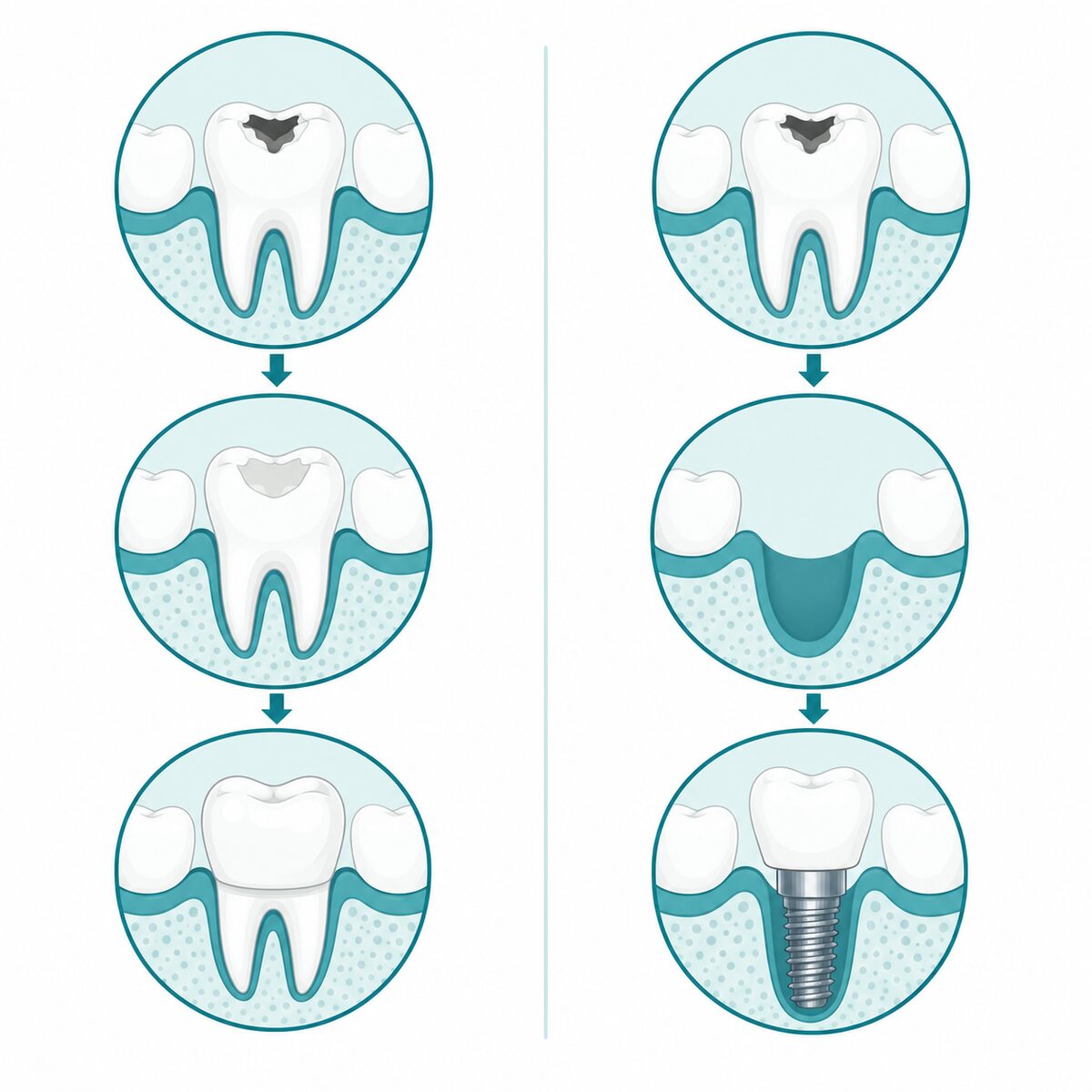
Root canal vs extraction comes down to one question: can this tooth still do its job? In most cases, saving a natural tooth beats pulling it, but not always. Here's how a dentist actually weighs the two so you can make the call with a clear head.
Root canal vs extraction: the real choice
When a tooth is badly decayed or infected, you're usually facing a root canal vs extraction decision. One saves the tooth. The other removes it. And the right answer isn't the same for everyone, which is exactly why a quick exam beats guesswork. Whether you should save tooth or extract it depends on how much healthy tooth is left, where it sits in your mouth, and what you want long term.
A root canal removes the infected pulp inside your tooth, cleans the canals, and seals them. The outer tooth stays. You usually finish with a crown on top, and that tooth can serve you for years. An extraction takes the whole tooth out. Done. The problem is gone, but so is the tooth, and now you have a gap to deal with.
People hear "root canal" and brace for pain. The truth is that a modern root canal treatment is done under local anaesthesia and feels a lot like getting a filling. The infection is what hurts. The treatment is what stops it. That's a point worth repeating, because fear of pain pushes a lot of people toward pulling a tooth that could easily have been saved.
Root canal vs extraction: the honest comparison
Neither option is the "right" one for everybody. It depends on how much healthy tooth is left, where the tooth sits, your budget, and your overall health. Here's the plain version.
| Factor | Root Canal (save the tooth) | Extraction (remove the tooth) |
|---|---|---|
| Keeps natural tooth | Yes | No |
| Typical cost in Lucknow | RCT ₹3,000 to ₹8,000 plus crown ₹3,000 to ₹15,000 | ₹500 to ₹3,000 (surgical ₹3,000 to ₹8,000) |
| Replacement needed later | No | Usually yes (implant, bridge, or denture) |
| Real long-term cost | One-time | Low now, higher once you add a replacement |
| Sittings | 1 to 2 (single-sitting often possible) | 1 |
| Chewing function | Stays close to natural | Drops until the gap is filled |
| Best when | Enough healthy tooth remains | Tooth is badly broken or loose |
Notice the cost trap. An extraction looks cheaper on the day. But an empty socket isn't the end of the story. Leave a gap and the neighbouring teeth start to tilt into it, the opposite tooth drifts down, and chewing shifts to one side. So most people end up replacing the tooth anyway, often with a dental implant that costs ₹25,000 to ₹50,000. Saving the tooth in the first place is frequently the cheaper road once you zoom out. For a full breakdown of what the treatment runs locally, see our root canal cost guide for Lucknow.
When a root canal is the better call
If the tooth is restorable, save it. That's the short version. A dentist will lean toward an RCT when:
- There's enough solid tooth structure left to hold a crown.
- The tooth roots are healthy and the surrounding bone is intact.
- It's a front tooth or a tooth that matters for your bite and smile.
- You'd rather not deal with a gap or a replacement down the line.
Nothing chews quite like the tooth you were born with. An implant is excellent, but it's still a substitute. Keeping the original is almost always worth a little extra effort.
When pulling it makes more sense
Sometimes a tooth is past saving, and forcing a root canal just delays the inevitable. Extraction tends to win when the crown is shattered below the gum line, when a deep crack runs into the root, when the tooth is loose from advanced gum disease, or when a wisdom tooth is impacted and causing trouble. In those cases, removing it and planning a clean replacement is the honest, less frustrating path.
And here's something people forget. An infection that's left to sit can spread to the bone and the tissue around it. If a tooth genuinely can't be saved, leaving it in "to avoid surgery" is the riskier choice, not the safer one. So the goal is never to pull a tooth out of fear, and never to save one that's beyond rescue. It's to match the treatment to the tooth.
If you do pull it, plan the replacement
An extraction shouldn't be the end of the plan. The moment a tooth comes out, the jawbone underneath starts to shrink, and the teeth on either side begin to drift. Leave the gap for a year or two and the simple replacement you could have done becomes a more involved one. So if extraction is the right call, decide on the replacement at the same time. A bridge, a denture, or an implant each suits a different case and budget. Talk it through up front, not later when the gap has already caused trouble.
This is where the maths really tilts. A good RCT Lucknow patients get done, plus a crown, is usually one round of treatment that lasts years. An extraction plus an implant means surgery, healing time, and a bigger total bill. Neither is wrong. But you want to choose with the full picture in front of you, not just the part you can see today.
What about the cost question
Money matters, and it's fair to ask. The thing to compare isn't the price on extraction day versus root canal day. It's the total over the next few years. A saved tooth is usually one bill. A pulled tooth is a small bill now plus a larger one later when you replace it. Run the full maths before you decide, not just the first number. And if a clinic pushes hard for extraction without explaining why the tooth can't be saved, it's perfectly reasonable to ask for a second opinion.
Sorting out your options
If the tooth can be saved, saving it is usually smarter for your health and your wallet. If it can't, a clean extraction with a solid replacement plan is the way to go. The only way to know which camp your tooth falls in is an exam and an X-ray. A two-minute look tells a dentist far more than a week of online reading ever will, so get it checked before you commit either way.
Frequently Asked Questions
Is a root canal always better than an extraction?
Not always, but usually. If enough healthy tooth remains, saving it keeps your natural bite and avoids the cost of a replacement. When a tooth is badly broken or loose, extraction is the sensible choice. An X-ray settles it quickly.
Is extraction cheaper than a root canal?
On the day, yes. But an empty gap usually needs a replacement like an implant or bridge, and that adds up to more than the root canal would have cost. Look at the total over a few years, not just the first bill.
Does a root canal hurt more than pulling the tooth?
No. Both are done under local anaesthesia, so you feel pressure but not pain during the procedure. The infection causes the pain you came in with, and either treatment stops it. Most people say it was easier than they expected.
What happens if I delay deciding?
An untreated infection can spread to the bone and nearby tissue, which turns a simple fix into a bigger one. If you're unsure between saving and removing the tooth, the safest move is to get examined soon rather than wait it out.