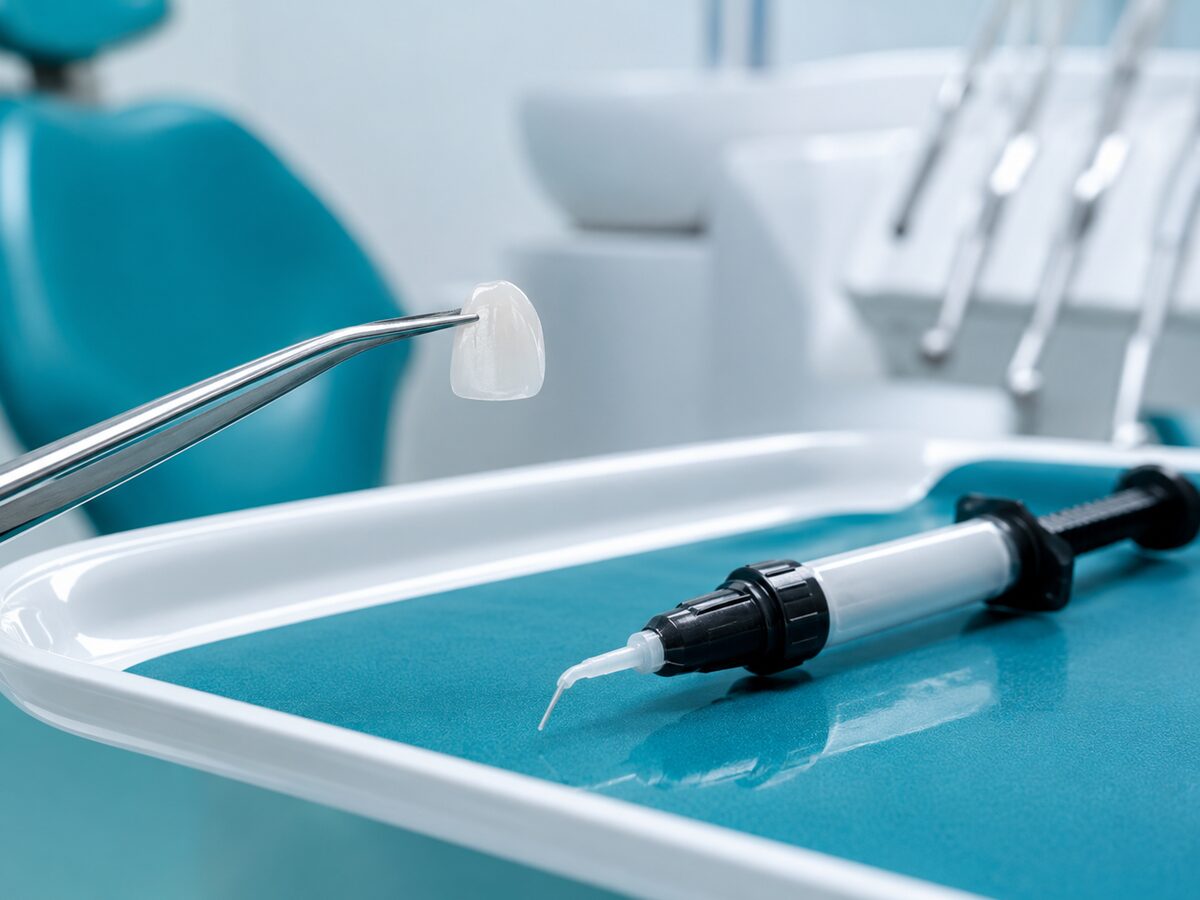
In the veneers vs bonding question, bonding is cheaper and faster while veneers look better and last far longer. Dental bonding fixes small chips and gaps in one sitting using tooth coloured resin. Veneers are thin porcelain shells that cover the front of your teeth for a flawless, durable result, at a higher cost.
Veneers vs bonding: what each one is
Both are cosmetic fixes for the front teeth you smile with. They solve similar problems, chips, gaps, stains, slightly crooked or worn teeth, but in very different ways.
Dental bonding uses a soft tooth coloured resin that your dentist applies straight onto the tooth, shapes by hand, and hardens with a light. It's done in one visit, often without even numbing you. Veneers are thin custom made shells, usually porcelain, that are bonded over the front surface of the tooth. They're crafted in a lab to match your smile exactly, so they take a couple of visits.
Put simply, bonding is a quick patch and reshape, while veneers are a tailored cover. Both fall under cosmetic dentistry, and which one fits depends on what you're fixing and your budget. The table below lays them side by side.
| Factor | Dental bonding | Porcelain veneers |
|---|---|---|
| Cost in Lucknow | Lower, similar to a composite filling | ₹8,000 to ₹20,000 per tooth |
| Visits needed | One sitting | Two visits usually |
| How long it lasts | 3 to 7 years | 10 to 15 years or more |
| Look | Very good, may stain over time | Excellent, stays bright |
| Tooth shaved down | Little to none | A thin layer removed |
| Stain resistance | Stains like natural teeth | Resists stains well |
| Reversible | Yes, mostly | No, enamel is removed |
| Repairable | Easy to touch up | Usually needs replacing if it chips |
Cost, straight up
Bonding is the budget friendly option. Because it's done chairside in one sitting with composite resin, it costs roughly what a tooth coloured filling does, far less than veneers. Veneers run about ₹8,000 to ₹20,000 per tooth in Lucknow, since each shell is custom made in a lab. Fix one small chip and bonding is the obvious choice. Redesign your whole smile and veneers may be worth the spend. For a fuller picture of a complete smile change and what goes into it, see our smile makeover cost guide.
How they look and last
This is where veneers earn their price. Porcelain catches light like real enamel and resists staining, so your smile stays bright for years. Bonding looks good too, genuinely good for small fixes, but the resin can pick up stains from tea, coffee, and paan over time, and it isn't quite as glossy as porcelain.
Lifespan splits the same way. Bonding typically lasts 3 to 7 years before it needs a touch up or redo. Veneers commonly last 10 to 15 years or more with care. So you're paying more upfront for veneers, but spreading that cost over more years often makes them reasonable per year.
One trade off in the other direction: bonding barely touches your natural tooth and is largely reversible. Veneers need a thin layer of enamel removed first, and that can't be undone. Once you commit to veneers, that tooth will always need a veneer or crown. Worth knowing before you decide.
What getting each one is like
Bonding is the easy chair visit. Your dentist roughens the tooth surface a touch, applies the resin, sculpts it into shape by hand, hardens it with a light, then polishes it. One sitting, often under an hour, and usually no anaesthetic. You walk out with the fix done.
Veneers take 2 visits. On the first, a thin sliver of enamel is shaped off and an impression or scan is taken, then sent to a lab. You wear temporary veneers for a week or two while the porcelain ones are made. On the second visit, your dentist checks the fit and colour, then bonds them on permanently. More steps, but the finish is worth the wait for the right case.
Looking after both
Neither is fully bulletproof. Don't bite your nails, open packets, or crack ice with treated front teeth, that's how bonding chips and veneers crack. Brush and floss as normal, and if you grind your teeth at night, a thin night guard protects your investment. Regular cleanings keep the edges healthy too.
Which one suits you?
Pick bonding if you've got a small chip, a minor gap, or one or two teeth to tidy up, if you want it done today, and if budget matters. It's also the gentler choice because almost no tooth is removed. A common case we see: a young patient chips a front tooth playing cricket in Aliganj and walks out an hour later with it fixed by bonding.
Pick veneers if you want to transform several front teeth, want the longest lasting and most stain proof result, and don't mind the higher cost and the permanence. People planning a wedding smile or fixing years of staining often choose veneers for that reason.
Sometimes the answer is a mix: bonding on one tooth, veneers on others, or starting with bonding and upgrading later. A quick consultation sorts out which makes sense for your teeth and your budget. You can book a checkup and talk it through.
Which one should you choose?
Bonding is cheaper, faster, gentler on your teeth, and easily repaired, but it lasts a few years and can stain. Veneers cost more and remove a little enamel, but they look flawless, resist stains, and last well over a decade. For a small fix, bond it. For a lasting smile makeover, veneers are usually worth it. Get your teeth assessed and let the recommendation match what you actually want to fix.
Frequently Asked Questions
Is bonding or veneers better for a chipped tooth?
For a single small chip, bonding is usually the smarter pick. It's done in one sitting, costs much less, and barely touches your natural tooth. Veneers make more sense when you want to redesign several teeth at once for the longest lasting, most stain resistant result.
How long does dental bonding last compared to veneers?
Bonding typically lasts 3 to 7 years before it needs a touch up, while porcelain veneers commonly last 10 to 15 years or more. Veneers cost more upfront but spread over those extra years, so per year the difference narrows. Good hygiene extends both.
Do veneers ruin your natural teeth?
Veneers don't ruin teeth, but they do require removing a thin layer of enamel, which can't be reversed. After that the tooth will always need a veneer or crown over it. Bonding, by contrast, removes little to no enamel and is largely reversible.
How much do veneers cost per tooth in Lucknow?
Porcelain veneers run roughly ₹8,000 to ₹20,000 per tooth, since each shell is custom made in a lab to match your smile. Bonding costs far less, similar to a tooth coloured filling. You'll get an exact quote after a checkup based on how many teeth you're treating.