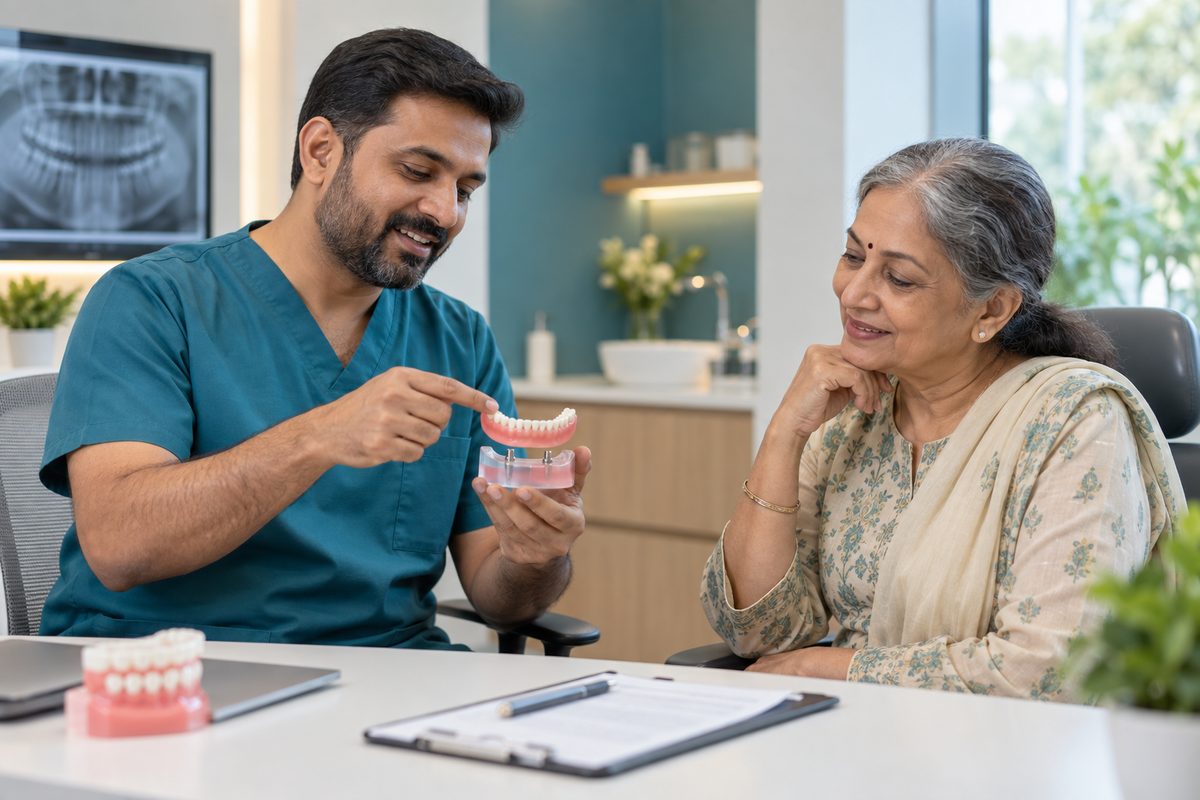
Implant supported dentures use a small number of implants to hold a full denture more firmly, especially in the lower jaw. They can reduce slipping and rubbing without needing an implant for every missing tooth. Removable and fixed designs are available, and the right choice depends on your bone, health, cleaning ability and expectations.
Why does a lower denture move more than an upper one?
A complete lower denture often has a harder job than an upper denture. The lower jaw has less surface area for the denture to rest on, and the tongue, cheeks and floor of the mouth keep moving around it. If the ridge has become flat after years without teeth, there may be very little for the denture to grip.
An upper denture usually gets more support because it covers a broader area of the palate and can form a better seal. That is why some people manage reasonably well with an upper denture but struggle with a lower one that lifts while talking, shifts while chewing or rubs sore spots into the gums.
A well-made conventional denture can still work. If yours is loose, we first check the fit, bite, gums and ridge shape. Sometimes an adjustment, reline or replacement denture is enough.
What are implant supported dentures?
Implant supported dentures use dental implants in the jaw as extra anchors. Instead of relying only on the gums and jaw ridge, the denture connects to small attachments fixed to the implants.
For a lower denture, a common removable design uses two to four implants. Matching attachments are built into the underside of the denture. You press the denture into place and it clicks or snaps onto the implants. This is why people sometimes call them snap on dentures.
The denture stays much steadier while you eat and speak, but you can still remove it for cleaning. Another design uses a metal bar joining the implants, with the denture clipping onto the bar. This removable option is often called an overdenture on implants.
How many implants are usually needed?
For a lower removable overdenture, two implants are often enough to make a large practical difference. Four implants may give more support and can be chosen when the jaw, bite or denture design calls for it.
The upper jaw often has softer bone, so more implants may be considered. We plan this from scans and examination rather than using one number for everyone.
If you are considering dental implants, we also check how much bone is present and whether any areas need grafting. Not everyone who has worn dentures for years needs a graft, but bone shrinkage can limit where an implant can safely be placed.
What is the fixed option?
A fixed implant bridge is different from a removable overdenture. More implants, often four to six, are used to support a full arch of replacement teeth. The bridge is screwed to the implants and is not taken out by you each night. If it needs to be removed, the dentist does that.
If you're comparing a fixed vs removable implant denture, the key difference is who removes it. The fixed bridge stays in place, but it still needs careful cleaning underneath.
If you have heard about All-on-4 treatment, that is one type of full arch fixed treatment. It is not the same as a two-implant removable overdenture.
Conventional denture, removable overdenture or fixed bridge?
| Option | Stability | Number of implants | Cleaning | Suits |
|---|---|---|---|---|
| Conventional denture | Lowest, especially in a flat lower ridge | None | Remove and clean daily | People who want no implant surgery or have a denture that already works acceptably |
| Implant-retained removable overdenture | Much steadier, but still removable | Commonly 2 to 4 in the lower jaw | Remove daily, clean denture and attachments | People mainly troubled by a loose lower denture |
| Fixed implant bridge | Very stable and dentist-removable | Often 4 to 6 | Clean underneath every day with special aids | People who want a fixed full arch and can maintain more involved hygiene |
Our implant vs bridge vs denture guide gives a broader comparison of tooth replacement choices.
What benefits can you realistically expect?
The biggest benefit is usually stability. A lower denture that lifts or slides can become easier to control once attached to implants.
Chewing often improves because the denture moves less. Speaking can feel more secure. Rubbing and repeated ulcers may reduce when the denture stops shifting over the gums, although sore spots can still happen if the fit or bite needs adjustment.
Implants also help preserve bone around the areas where they are placed. They do not stop all bone change across the whole jaw, but they can reduce shrinkage around the implant sites.
This extra stability can also improve confidence while eating and speaking, although the denture still needs maintenance.
Who is a good candidate?
Implant supported dentures may suit you if your lower denture is repeatedly loose, you have enough bone or bone that can be grafted, your general health allows minor oral surgery, and you are willing to clean the implants and denture every day.
Age by itself is usually less important than health, bone, medicines, smoking, diabetes control, gum condition and your ability to keep the area clean.
They may be less suitable if implant surgery is medically unsafe or if oral hygiene is poor. In some cases a family member or carer may need to help with cleaning.
What does the treatment involve?
We first examine the mouth and take suitable X-rays or a 3D scan when needed. We look at the amount of bone, the position of nerves and sinuses, the bite, the condition of your present denture and the shape of the jaw.
The implants are placed under local anaesthetic. Many removable lower overdentures use implants in the front part of the lower jaw. In most cases the implants are then allowed to heal for a few months before they take full chewing load.
During healing, you may continue with a denture after it has been adjusted so it does not press heavily on the implant sites. Once the implants have integrated with the bone, the attachment parts are connected and the denture is modified or remade to fit them.
Healing time varies. A few months is common, but bone quality, grafting, medical conditions and the treatment design can change the schedule.
What maintenance should you expect?
An implant denture still needs daily cleaning around the implant attachments and underneath the denture.
The small clip or nylon inserts inside the denture gradually wear. When the denture starts feeling less retentive, these parts can usually be replaced. The denture base may also need relining later because the jaw and gums continue to change with time.
Fixed bridges also need careful cleaning underneath, often with interdental brushes, floss threaders or a water flosser depending on the design. Regular reviews help us check the implants, bite, denture fit and attachments.
Is it better than an ordinary denture?
It depends on what is bothering you.
If your ordinary denture fits well, lets you chew comfortably and stays in place, you may not gain enough from implants to justify surgery and extra maintenance. If the main problem is a lower denture that keeps lifting or rubbing, an implant-retained overdenture can be a practical step up without using a full set of implants.
People sometimes search for a denture that does not slip. No removable denture can be promised to feel exactly like natural teeth, but implant retention can reduce the movement that causes the most frustration.
For fees and the factors that affect them, see our denture cost guide. We do not choose the design by price alone. Bone, stability needs, cleaning ability and the condition of your present denture matter too.
What should you ask at your consultation?
Bring your current denture even if you dislike it. It helps us assess your bite, support and sore spots.
Ask whether your existing denture can be converted to work with implants or whether a new one would be better. Ask how many implants are being suggested and why, whether a bar is needed, how you will clean the design, what parts may need replacing later, and how long you are likely to use a temporary denture during healing.
If a loose denture is limiting what you eat or making you avoid speaking comfortably, you can book a denture consultation at Haihyvanshi Dental Clinic & Implant Centre on IIM Road. We can check whether a simpler reline is enough or whether implant support would give you better stability.
Frequently Asked Questions
How many implants do I need for a lower denture?
Many lower removable overdentures can be retained by two implants, while some cases use four for added support or because of the planned design. The number depends on available bone, bite and denture shape. A scan and examination are needed before deciding. Using more implants is not automatically better if a simpler design will meet your needs.
Can my existing denture be used with implants?
Sometimes. If the denture is in good condition, has a suitable bite and enough room for the attachment parts, it may be possible to modify it. In other cases, making a new denture gives a better fit and stronger base. We need to examine both the denture and your mouth before advising which route makes sense.
Do implant supported dentures have to be removed at night?
A removable implant overdenture is normally taken out for daily cleaning and is often removed at night, unless your dentist gives different instructions for your case. A fixed implant bridge stays in the mouth and is removed only by the dentist, but you still need to clean carefully underneath it every day.
How long does implant denture treatment take?
The implant healing stage commonly takes a few months. Your exact schedule depends on the bone, the number of implants, whether grafting is needed and how the temporary denture is managed. After healing, the attachments are connected and the denture is fitted or remade. Grafting or slower healing can extend the treatment time.