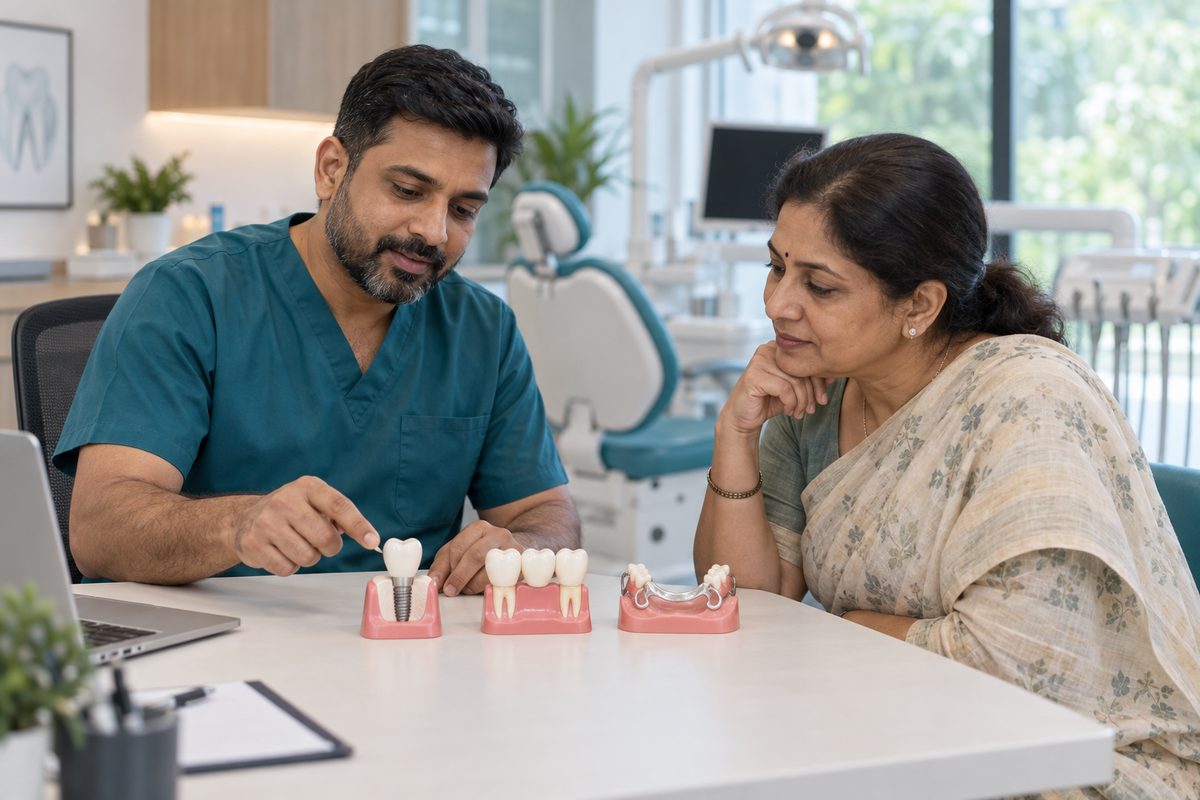
Dental implant vs bridge vs denture comes down to your teeth, bone, health, budget and whether you want a fixed or removable option. For most patients we see in Lucknow, implants protect neighbouring teeth and jaw bone best, bridges are the faster fixed option, and dentures are often the quickest and lowest-cost choice when many teeth are missing.
What is the difference between an implant, bridge and denture?
If you have a missing tooth, the right choice depends on how many teeth are missing, the condition of the teeth beside the gap, your gums and jaw bone, your general health, your budget, and how quickly you want treatment finished. At our clinic in Lucknow, we look at these points rather than saying one option is best for everyone.
A dental implant replaces the tooth root as well as the visible tooth. A small titanium post is placed into the jaw bone and given time to heal firmly, usually over a few months, before the final crown is fitted. You can read more about our dental implants if you want to understand the treatment steps.
A dental bridge fills the gap with an artificial tooth supported by crowns on the teeth on either side. Those neighbouring teeth usually need to be trimmed so the crowns can fit. A dental bridge is fixed in the mouth, so you don't remove it for cleaning.
A denture is removable. It can replace a few teeth as a partial denture or all teeth in an arch as a complete denture. Dentures can be practical when many teeth are missing, especially when surgery is not suitable or the budget is limited.
Which option is usually the longest lasting?
With good oral hygiene and regular dental reviews, an implant is often the longest-lasting option. The implant post can often function for 15 years or more, although the crown above it may need replacement earlier. Gum disease, smoking, poor cleaning and some medical conditions can shorten its working life. Our guide on how long implants last explains these factors.
A bridge can also work well for many years, but it depends heavily on the health of the supporting teeth. If one develops decay, gum disease or a root problem, the bridge may need treatment or replacement.
Dentures wear, and the shape of your gums changes with time. They may need relining, adjustment or remaking so they continue to fit properly.
Dental implant vs bridge vs denture at a glance
| Option | Fixed or removable | Affects neighbouring teeth | Time to finish | Protects jaw bone | Typical lifespan with care |
|---|---|---|---|---|---|
| Dental implant | Fixed | Usually no trimming of neighbouring teeth | Usually a few months because healing is needed before the final crown | Helps preserve bone around the implant | Implant itself often 15 years or more, while the crown may need replacement sooner |
| Dental bridge | Fixed | Yes, supporting teeth usually need trimming | Usually a couple of visits after planning | Does not stop bone loss under the gap | Around 10 to 15 years, but this varies with supporting tooth health |
| Denture | Removable | Usually no major trimming, although partial dentures may use nearby teeth for support | Often the quickest option, usually over a few visits | Conventional dentures do not prevent gradual bone shrinkage | Often around 5 to 8 years before relining or remaking is needed, depending on fit and wear |
These are broad ranges, not expiry dates. Some restorations last longer and some need attention earlier.
Who usually suits an implant, bridge or denture?
If you're deciding between implant or bridge, the teeth beside the gap matter a lot. An implant is often attractive when one tooth is missing and the neighbouring teeth are healthy, because we don't have to cut those teeth down. It also transfers chewing load into the jaw bone, helping reduce bone loss around the missing tooth area.
A bridge can make sense if the teeth beside the gap already have large fillings or crowns and can support one. It is faster than implant treatment because there is no implant healing period. The trade-off is that you need to clean carefully under it.
Dentures are often considered when several teeth are missing, when all teeth in one or both arches are missing, or when someone wants a lower-cost and quicker way to replace missing teeth. They can also suit people who prefer to avoid implant surgery or whose health makes elective oral surgery less suitable.
A simple way to think about it is:
- One missing tooth with healthy teeth beside it: an implant is often considered first, while a bridge may still suit you if you want a faster fixed option or the supporting teeth already need crowns.
- Several teeth missing in a row: implants may support crowns or a fixed bridge, while a partial denture can replace several teeth without placing an implant for every tooth.
- All or nearly all teeth missing: complete dentures are the simplest removable option. Implant-supported dentures can be a middle option, using implants to improve stability while the denture remains removable in many designs. Some suitable patients may also be assessed for All-on-4 for a full arch.
Older age by itself does not rule out implants. Bone quality, gum health, healing ability and general medical fitness matter more. Smoking can slow healing and increase implant complications. Uncontrolled diabetes can also affect healing, so we would want it properly managed before implant surgery.
What are the practical drawbacks of each choice?
With an implant, you need a minor surgical procedure and enough healthy jaw bone to support it. If the bone has shrunk significantly, bone grafting may be discussed in some cases. Gum health also needs to be under control. Treatment takes longer because the implant generally needs a healing period of a few months before the final crown.
A bridge avoids implant surgery and is usually faster, often taking a couple of visits. The main drawback is trimming the neighbouring teeth. You also need to clean under it using floss threaders or small interdental brushes. It does not stop the jaw bone underneath from gradually shrinking.
A denture is usually the most affordable and quickest route when many teeth are missing, but it takes time to get used to. Eating and speaking can feel different at first. As the gums and bone change, a denture may feel loose and need relining or remaking. Our denture cost guide explains what can affect the fee.
For implants, costs depend on how many teeth are being replaced, the implant system, the crown, whether bone grafting is needed and whether treatment is for one tooth or several. Our implant cost guide explains these factors without reducing the decision to one figure.
Is it okay to leave a missing tooth alone?
You may get used to the gap, but the mouth can still change even if it is not painful.
Teeth beside the space may gradually tilt or drift. The opposite tooth may move further into the gap because it no longer has a tooth to bite against. Your bite can change, food can trap more easily, and the jaw bone in the missing tooth area usually shrinks because it is no longer receiving normal stimulation from a tooth root.
This doesn't mean every gap needs the same treatment. A back tooth missing for years may need a different plan from a newly lost front tooth. It is better to have the space assessed than to assume nothing will change.
What happens at a consultation?
At a consultation with Dr. Jai Prakash Haihyvanshi, we first examine your teeth, gums and bite. We then take an X-ray or scan when needed to see how much bone is available and to check the roots and supporting structures around the gap.
After that, we explain which options are realistic, how long treatment is likely to take and what maintenance it needs. You should understand the plan and the costs before anything starts.
If you're considering dental implants, the scan and examination help us judge the available bone, gum condition and position of nearby teeth. For a bridge, we check whether the supporting teeth are strong enough. For a denture, we look at the gums, remaining teeth and bite so the appliance can be planned sensibly.
There isn't one correct answer for every missing tooth. If you want us to examine the gap and explain the choices for your mouth, you can book a consultation at Haihyvanshi Dental Clinic & Implant Centre on IIM Road, Jankipuram.
Frequently Asked Questions
Is an implant better than a bridge for one missing tooth?
If the teeth beside the gap are healthy, an implant is often considered because it replaces the missing root without trimming those neighbouring teeth. A bridge may still be a sensible choice if the supporting teeth already need crowns, you want a faster fixed treatment, or implant surgery is not suitable for you.
Can I get a dental implant if I am older?
Age alone does not usually decide implant suitability. We look more closely at your jaw bone, gum health, medical conditions, medicines, smoking history and ability to heal. Some older adults are suitable for implants, while others may be better served by a bridge, denture or implant-supported denture after examination and imaging.
Will dentures become loose after a few years?
They can. After teeth are lost, the gums and jaw bone slowly change shape. A denture that fitted well at first may become less stable over time. Adjustments or relining can help in some cases, while an older or worn denture may need remaking. Regular reviews help us check fit, sore spots and your bite.
Can a bridge be finished faster than an implant?
Usually, yes. A conventional bridge can often be completed in a couple of visits after planning, while an implant commonly needs a healing period of a few months before the final crown is fitted. The quicker option is not automatically the better one, because the condition of the neighbouring teeth and jaw bone also matters.