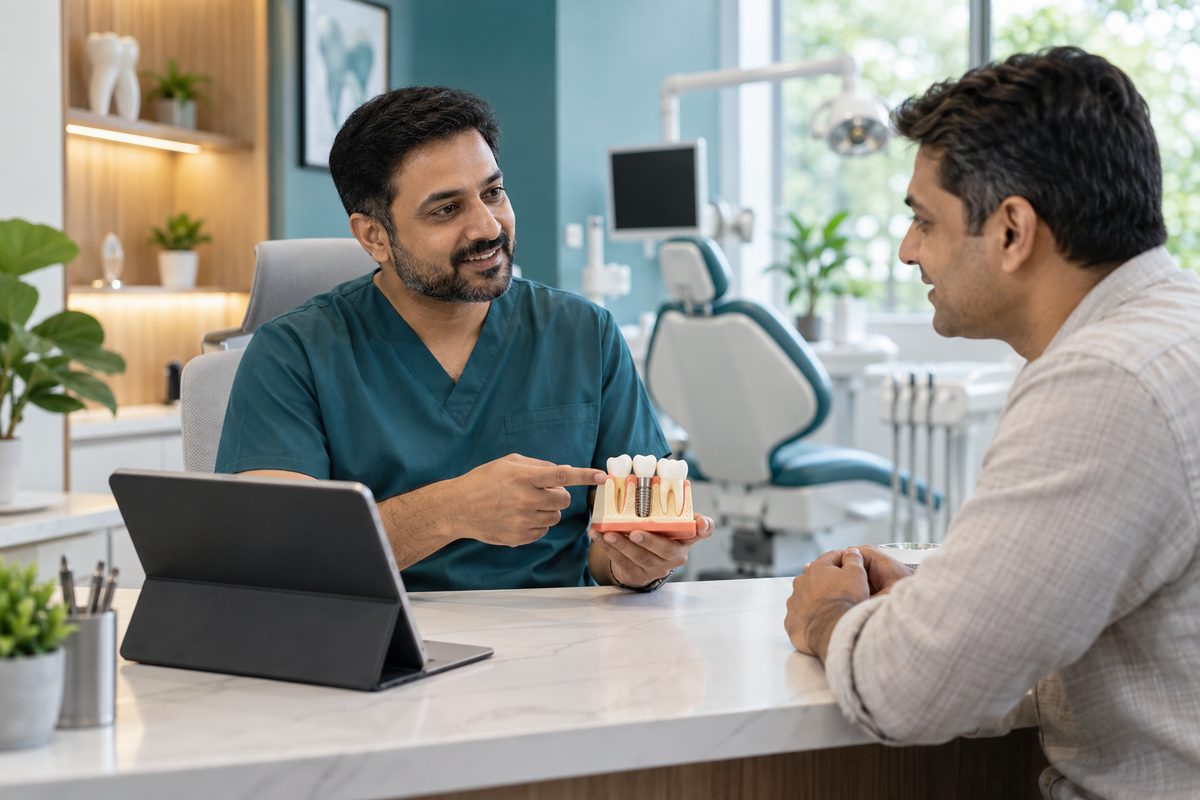
Immediate dental implants can shorten the visible part of treatment, but "teeth in a day" does not mean the implant has finished healing in one day. In suitable cases, we may place an implant when a tooth is removed and sometimes fit a temporary tooth at the same visit, while the implant still needs months to bond with the bone.
What does "teeth in a day" actually mean?
The phrase can be confusing because two different treatments are often advertised under the same name.
The first is placing an implant immediately after a tooth is removed. This is immediate implant placement. Instead of removing the tooth and waiting for the socket to heal, we place the implant into the extraction area during the same appointment if the bone and surrounding tissues are suitable.
The second is putting a temporary tooth on the implant soon after it is placed. This is called immediate loading. The temporary crown or bridge may be fitted on day one, but it is not the final restoration.
You can have one without the other. We may place an implant the same day as extraction but leave it without a tooth attached if it is not firm enough for safe loading. That is why an advertisement for same day dental implants does not tell you exactly what treatment you will receive.
What is done on day one, and what still takes months?
Same-day treatment changes the schedule, not the biology of healing. The implant still needs time to fuse with the surrounding jawbone. Dentists call this osseointegration.
A temporary crown fitted on the first day is usually made to take very little biting force. On a front tooth, we may keep it slightly out of the main bite. You will normally be asked not to bite hard food directly on it.
| What is done on day one | What still takes months | Who it suits |
|---|---|---|
| Tooth removal if needed, implant placement, and sometimes a temporary crown or bridge | Bone healing around the implant, gum maturation, and the final crown or bridge | Selected patients with healthy gums, enough suitable bone and good implant stability |
The final crown usually comes later, after we are satisfied that the implant has healed well and the gum is stable. Our implant treatment timeline explains the usual stages in more detail.
Can an implant be placed on the same day as an extraction?
Sometimes, yes. An implant same day as extraction can work well when the socket is suitable, there is enough bone to hold the implant firmly, and the area can be cleaned properly.
The key point is primary stability. The implant needs to feel mechanically firm in the bone at the time of placement. If the bone is softer or thinner than expected, attaching a temporary tooth may add unnecessary risk.
We also look at the gum line, the shape of the socket and the amount of bone around it. This matters especially in front teeth, where changes in gum position can affect appearance.
If there is not enough bone, we may recommend bone grafting, either at the same visit or as a separate stage.
Who is usually a good candidate for immediate dental implants?
A same-day plan is more likely to be considered when your mouth gives the implant a stable, clean environment.
Typical factors we look for are:
- Enough healthy bone to hold the implant firmly.
- Healthy gums with no active infection at the site.
- A bite that does not overload the temporary tooth.
- No smoking, or a willingness to stop.
- Medical conditions such as diabetes being well controlled.
For a single front tooth, the temporary crown is often shaped to protect the implant rather than to let you chew normally on it. For a full arch, several implants may be connected so they share the load. In selected cases, All-on-4 for a full arch can use this type of immediate temporary bridge.
Wanting fast treatment is not enough on its own. Your scan, bone quality, bite and general health all have to support the plan.
Who usually should not have same-day loading?
We are more cautious if there is a heavy infection or abscess at the site, poor bone quantity or quality, uncontrolled diabetes, heavy smoking, severe grinding or clenching, or a bite that puts strong pressure on the temporary tooth.
Another reason to change the plan is simple. The implant may not be firm enough when it is inserted.
A CBCT scan gives us useful information about bone height, width and nearby structures, but the final decision about immediate loading is sometimes made during surgery. If the implant does not achieve the stability we need, we may let it heal without a tooth attached to it.
That does not mean the treatment has failed. It means the plan has been changed to protect healing.
What are the benefits of same day dental implants?
For the right patient, there can be practical benefits. There may be fewer surgical visits because extraction and implant placement are combined. If a temporary tooth can be fitted, you may avoid a visible gap during healing. In some cases, the temporary tooth can also help support the shape of the gum while the tissues settle.
These benefits should not push every patient into immediate treatment. Conventional dental implants are often the better choice when the site needs time before loading.
What are the risks with immediate loading?
With an immediate loading implant, the main concern is movement. An implant needs to remain stable while new bone forms around it. If the temporary tooth receives too much force too early, there is a higher chance that the implant will not integrate.
That is why the temporary restoration is usually kept light in the bite, and why a soft diet matters. For several weeks you may need to avoid hard crusts, nuts, raw hard vegetables, sticky foods and direct biting on the temporary tooth.
The plan can also change during surgery. A scan may look promising, but if the bone is softer than expected or the implant is not stable enough, we may decide not to load it that day.
If you grind your teeth, that also needs to be considered before immediate loading.
What happens before we decide you qualify?
The decision starts with an examination, not with an advertisement.
We check the tooth or missing-tooth area, gum health, bite, neighbouring teeth and your medical history. A CBCT scan is commonly used to assess the three-dimensional bone available for implant placement and nearby structures.
We also ask about smoking, diabetes control, medicines and grinding or clenching. Active infection has to be assessed carefully and may rule out a same-day plan, especially if there is significant swelling, pus or loss of supporting bone.
For full-arch treatment, planning is more involved because implant positions, bone distribution and the way the temporary bridge takes biting forces all have to work together.
Are the temporary teeth the final teeth?
Usually not.
Temporary teeth on implants are designed for the healing period. They can protect appearance and help shape the gum while the implant bonds with the bone. Your gums can change during healing, so the final crown or bridge is normally made later.
Once the implant has integrated and the tissues are stable, we can plan the final bite, contact points, tooth shape and material more accurately.
So if you see "teeth in a day", read it as "temporary teeth may be possible on day one in selected cases", not "the whole implant treatment is completed in one day".
How should you compare cost and treatment options?
Immediate treatment may involve an extraction, grafting, a temporary crown or bridge, and one or more implants. Rather than relying on one advertised figure, compare exactly what is included in the plan.
Our implant cost guide explains the main factors that can change the total fee.
A useful question at consultation is, "If you place and load the implant today, what makes my site suitable, and what would make you change the plan?"
The scan and examination decide, not the advertisement
Same-day treatment can be a good option when the bone, gums, bite and general health support it. The safer plan is the one that gives the implant the best chance to heal, even if that means waiting before a temporary or final tooth is attached.
If you want to know whether immediate dental implants are realistic for you, you can book an implant assessment with Dr. Jai Prakash Haihyvanshi at Haihyvanshi Dental Clinic & Implant Centre on IIM Road.
Frequently Asked Questions
Can I really get a tooth on the same day as an implant?
Sometimes. If the implant is firm enough in the bone and your bite can be kept away from the temporary crown, we may place a temporary tooth on the same day. It is usually a healing-phase tooth, not the final crown. The implant still needs several months to bond securely with the jawbone.
Can an implant be placed immediately after a tooth is removed?
Yes, in selected cases. The extraction socket must have enough suitable bone for the implant to be placed firmly, and the area must be manageable from an infection and gum-health point of view. If the socket is badly damaged or the implant is not stable enough, waiting can be the safer option.
What if the dentist plans same-day teeth but changes the plan during surgery?
That can happen, and it is not necessarily a problem. A CBCT helps us plan, but the true firmness of the implant is confirmed when it is placed. If the bone is softer than expected, we may leave the implant unloaded and use another temporary option while it heals.
Do I have to eat soft food after immediate loading?
Yes. A soft diet is a key part of protecting an immediate loading implant during early healing. Avoid hard, crunchy and sticky foods, and do not bite directly on a temporary front tooth unless your dentist has said it is safe. The exact restrictions depend on where the implant is and how the temporary tooth is designed.