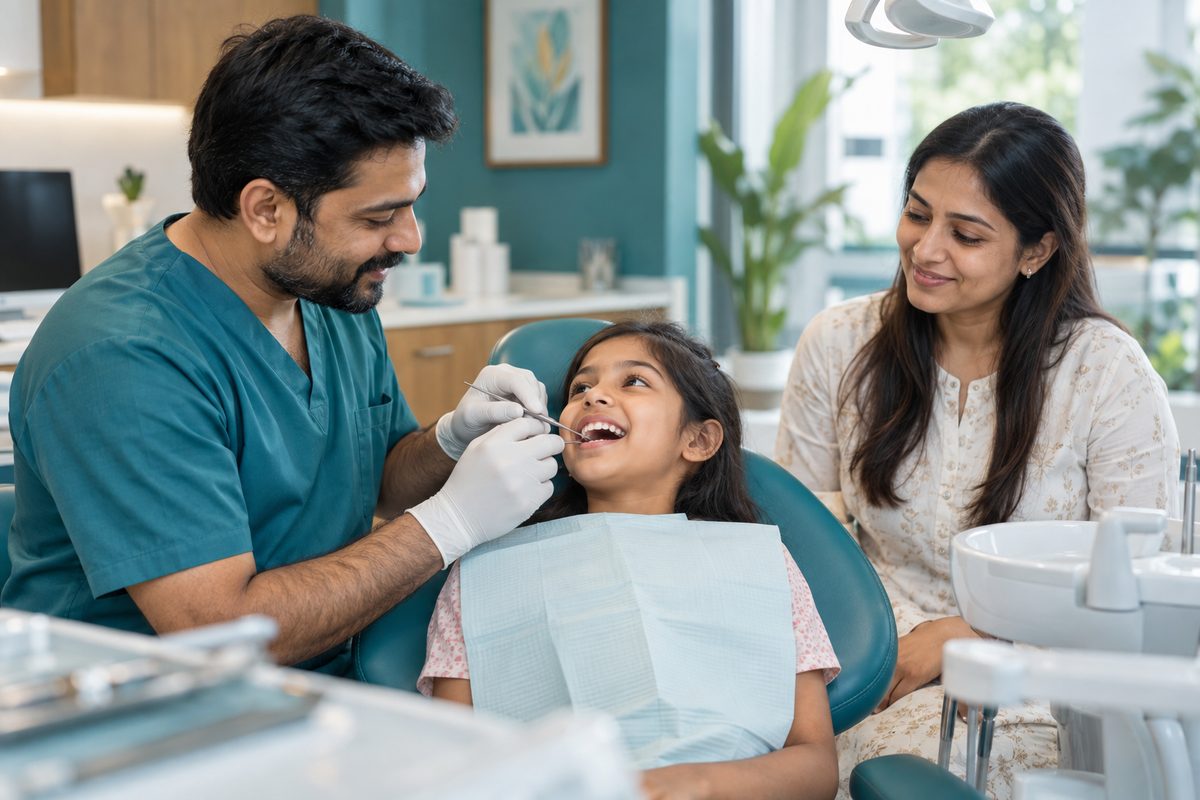
The right age for braces is different for every child, but a first orthodontic check is usually advised at about age 7. Most children who need fixed braces start around 11 to 14, once most adult teeth are through, although some bite or jaw problems are better treated earlier.
When should a child get their first orthodontic check?
A first orthodontic check is commonly advised at about age 7. That can sound surprisingly early, especially if your child still has many baby teeth, but the visit is mainly about checking growth and development. It does not mean braces will be fitted at that age.
By around 7, the first adult molars and the front adult teeth are usually coming through. This gives us a useful view of how the jaws are growing, whether there is enough room for the adult teeth, and whether the bite is developing normally.
For many children, the best advice after this first check is simply to watch and wait. We may review them again after several months or a year, depending on what we see. If there is a problem that is easier to guide while the jaws are still growing, we can explain that early rather than discovering it much later.
Our children's dentistry service also includes routine checks of tooth eruption, bite development and habits that may affect the way the teeth and jaws grow.
Does a check at age 7 mean braces at age 7?
No. This is one of the most common misunderstandings parents have.
Most children who need fixed braces start treatment between about 11 and 14, when most of the adult teeth have come through. At that stage, there are enough permanent teeth to line up, and the jaws are still growing, which can be useful in planning treatment.
The exact braces age depends on the child. Some 11 year olds are ready, while some 13 or 14 year olds still need more time for teeth to erupt. We look at dental development, not just the birthday.
Treatment at 7 or 8 is usually reserved for selected problems, not for every child with a slightly crooked front tooth.
When can early braces for kids be useful?
Early treatment is sometimes called interceptive treatment. The aim is to deal with a specific developing problem before it becomes harder to manage.
It may be considered when there is a crossbite, a very narrow upper jaw, severe crowding, front teeth that stick out enough to be at greater risk of injury, or a habit such as thumb sucking that is affecting the bite. A jaw that shifts to one side on closing can also need earlier assessment.
In these situations, treatment may involve an appliance, an expander, limited braces or another method chosen for the problem. The purpose is not always to finish all orthodontic treatment early. Sometimes the aim is to improve jaw position or create space, followed by a second stage later when more adult teeth are present.
Early treatment can make later treatment simpler in some children, but it should be recommended for a clear reason. If early treatment is unlikely to help, waiting is often the better choice.
What signs should parents look for?
You do not need to judge your child's bite at home, but some signs are a good reason to arrange a check:
- Crowded or overlapping teeth, front teeth that stick out, difficulty chewing or biting, mouth breathing, thumb sucking after age 4, baby teeth being lost very early or very late, or the jaw shifting to one side when your child closes their mouth.
Crooked teeth in children do not always mean urgent treatment. A child may have temporary crowding while adult teeth are erupting. The point of the check is to separate normal development from a problem that is better treated earlier.
If you are unsure who should assess a younger child, our guide to choosing a kids' dentist explains what parents can look for in a child friendly dental visit.
Should you wait until all the baby teeth have fallen out?
Not always.
There is a common belief that nothing should be done until every baby tooth is gone. For routine full braces, waiting until most adult teeth are through is often sensible. But some bite and jaw problems are easier to correct while a child is still growing.
For example, a crossbite that makes the jaw shift to one side may affect the way the bite develops. A narrow upper jaw may be easier to widen at a younger age than after growth is complete. Very prominent front teeth may also need earlier attention if they are at higher risk of being knocked or chipped.
So the better rule is not "wait for all baby teeth". It is "check at the right time, then treat only if there is a reason".
What usually happens at different ages?
| Age | What is usually happening | What a dentist looks for |
|---|---|---|
| About 6 to 8 | First adult molars and front teeth are erupting | Crossbite, jaw shift, lack of space, very prominent front teeth, harmful habits |
| About 9 to 10 | A mix of baby and adult teeth is common | Whether crowding is increasing, whether jaws are growing evenly, eruption problems |
| About 11 to 14 | Most adult teeth are usually present | Whether full braces are needed and whether the timing is right |
| Older teens and adults | Growth is more complete, but teeth can still be moved | Gum and bone health, bite, crowding, treatment choices |
This is only a general guide. Two children of the same age can be at quite different stages of dental development.
What happens during the first orthodontic check?
The first orthodontic check is usually straightforward. We look at how the upper and lower teeth meet, how much space there is, whether the jaws are growing evenly and whether any teeth seem delayed or blocked from coming through.
We may take photographs. X-rays are sometimes needed, especially if we need to see where unerupted adult teeth are sitting, but they are not taken simply because a child has come for a check.
After that, the advice should be clear. There are usually three possibilities: treat now, monitor for a while, or wait until more adult teeth have erupted.
Parents often find the "monitor" option reassuring because it means the child is being watched without starting treatment before it is needed.
What if my child definitely needs braces later?
If braces are likely to be needed, the next question is which type and when to start. Fixed metal braces are still widely used for children and teenagers. Clearer options may suit some older teenagers, depending on the case and how reliably they can wear them.
You can read about our braces and aligners service for an outline of treatment choices. If you are comparing removable clear aligners with fixed braces, our guide to aligners versus braces explains the practical differences.
Parents also ask about fees early in the process. Costs vary with the type of appliance and the length and complexity of treatment, so we do not use one figure for every child. Our braces cost guide explains what can affect the fee.
Can adults have braces too?
Yes. There is no fixed upper age limit for orthodontic treatment.
Adults can have braces or aligners if the teeth, gums and supporting bone are healthy enough for tooth movement. Treatment planning may be different if there is gum disease, missing teeth, crowns or implants, so these need to be assessed first.
The main point is that age alone does not decide whether orthodontic treatment is possible.
So what is the right age for braces?
For most children, the first check is around age 7, while full fixed braces, if needed, often start around 11 to 14. Some children benefit from treatment earlier because of a bite, jaw or space problem. Others are best monitored until more adult teeth come through.
If your child has obvious crowding, a crossbite, very prominent front teeth, a jaw shift, chewing difficulty or a long standing thumb sucking habit, there is no need to wait for every baby tooth to fall out before asking.
At Haihyvanshi Dental Clinic & Implant Centre, we can examine your child's bite, explain whether treatment is needed now or later, and keep the plan as simple as possible. To arrange a visit at our IIM Road clinic in Lucknow, you can book an orthodontic check.
Frequently Asked Questions
My child is 7. Will they need braces straight away?
No. The first orthodontic check at about age 7 is mainly to look at jaw growth, bite and space for adult teeth. Many children are simply monitored. Braces or another appliance may be advised early only when there is a specific problem that is easier to correct while the jaws are still growing.
Should I wait until all the baby teeth have fallen out before booking a check?
Not necessarily. Full fixed braces often start after most adult teeth have erupted, but some problems are better assessed sooner. Crossbites, a narrow upper jaw, severe crowding, very prominent front teeth or a jaw shift may benefit from earlier treatment. A check can tell you whether to treat now, monitor or wait.
My child has crooked front teeth at age 9. Is that normal?
Some crowding can appear temporarily while adult teeth are coming through, so crooked front teeth at 9 do not automatically mean braces are needed immediately. We would check how much space is available, how the bite fits together and whether the teeth are erupting normally. The right timing depends on development, not age alone.
Can teenagers start braces after age 14?
Yes. Age 11 to 14 is a common time to start fixed braces, but it is not a deadline. Some teenagers are ready later because their adult teeth erupt more slowly or because treatment was not needed earlier. Braces can also be used in adults when the gums and supporting bone are healthy enough for tooth movement.