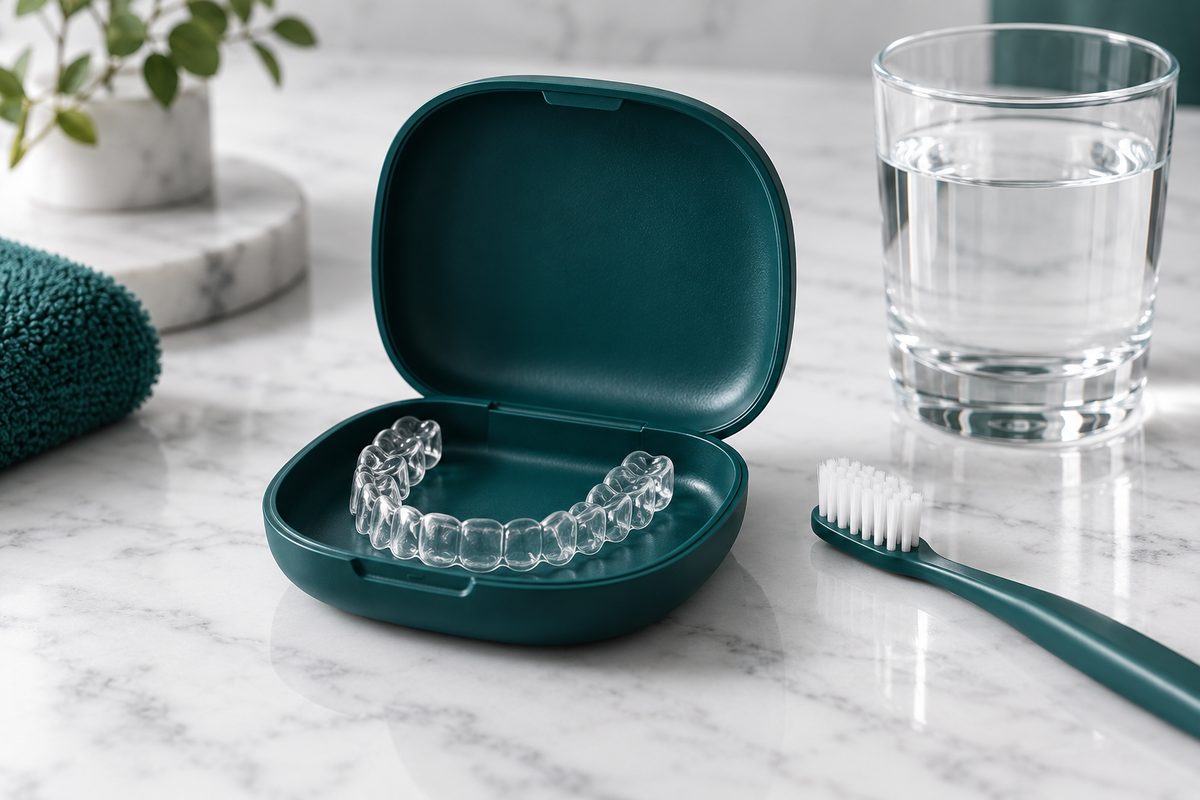
A retainer after braces is what helps keep your teeth in the positions your orthodontic treatment created. Most people wear one full-time at first, then at night for the long term, because teeth can gradually move again if retention is stopped.
Why do you need a retainer after braces?
Taking your braces off, or finishing your last aligner, doesn't mean your teeth are completely settled in their new positions.
Teeth sit in bone and are supported by fibres around their roots. During orthodontic treatment, these tissues slowly remodel as teeth move. Once treatment finishes, the fibres and surrounding bone continue adapting for some time. There is also a natural tendency for teeth to shift throughout life.
A retainer holds your teeth while this settling takes place.
Without one, teeth can start moving towards their previous positions. This is called orthodontic relapse. The lower front teeth are particularly prone to becoming crowded again.
So if you've spent months or years wearing braces and aligners, the retainer is not an optional extra at the end. It's part of keeping the result.
How long do you need to wear retainers?
One of the most common questions we hear is, "How long to wear retainers after treatment?"
There isn't one identical schedule for everybody because it depends on how much your teeth were moved, the original crowding, your bite, your age and the type of retainer you have.
A common approach is to wear a removable retainer full-time for the first few months. That normally means wearing it during the day and night, taking it out for meals, cleaning and brushing.
After that, many patients move to night-time wear.
For long-term stability, most orthodontists now advise continuing some form of retention for as long as you want your teeth to remain as straight as possible. When dentists say "for life", that doesn't necessarily mean wearing a removable retainer every night forever. After the initial retention period, some people may eventually be advised to wear it a few nights each week.
The exact schedule should come from the dentist or orthodontist who treated you.
Your teeth don't suddenly become incapable of moving once you reach a certain age. Even people who completed orthodontic treatment many years ago can notice gradual crowding.
Fixed vs removable retainer
There are two main ways of retaining teeth after orthodontic treatment. Some patients use one type. Others have both.
| Type | How it works | Pros | Things to watch |
|---|---|---|---|
| Fixed bonded wire | A thin wire is bonded to the back of the front teeth, commonly the lower teeth | Works all the time and you don't have to remember to put it in | Needs careful cleaning. Bonding can loosen and tartar can collect around the wire |
| Removable retainer | A clear plastic or Hawley retainer fits over the teeth and is removed for meals and cleaning | Easy to inspect and clean, and can retain several teeth at once | Only works if you actually wear it. It can be lost, cracked, warped or thrown away accidentally |
What is a fixed retainer?
A fixed retainer is a thin wire bonded behind the front teeth. Because it sits on the tongue side, it usually isn't visible when you smile.
Its biggest advantage is that you don't need to remember to wear it each night. It stays in place continuously.
But fixed doesn't mean maintenance-free.
Plaque and tartar can collect around the wire, especially behind the lower front teeth. You need to clean under and around it with floss threaders, suitable interdental brushes or another method recommended by your dentist.
You should also occasionally check the wire with your tongue. If part of it feels loose or the wire seems to have lifted away from a tooth, arrange a dental check. A section can debond without the entire retainer falling out, and that tooth may then start moving.
What is a removable retainer?
Clear retainers look similar to thin clear aligners. They fit closely over the teeth and are easy to remove.
A Hawley retainer is another removable option. It normally uses an acrylic section with a wire running across the front teeth.
Both can work well when worn as prescribed.
If you are still deciding between orthodontic options, our guide to aligners vs braces explains how the treatments differ. Adults considering treatment may also find our page on braces for adults useful.
How should you clean your removable retainer?
A retainer spends many hours against your teeth, so keeping it clean matters.
A simple routine is usually enough:
- Rinse it with cool or lukewarm water when you take it out. Gently clean it with mild soap or a suitable retainer cleaner, keep it in its case when you're not wearing it, never put it in hot or boiling water, don't wrap it in a tissue or napkin, and keep the case away from pets.
Very hot water can distort plastic retainers. Once the shape changes, the retainer may no longer fit correctly.
Your toothbrush can be used gently if your dentist has advised it, but avoid aggressive scrubbing or abrasive toothpaste that can roughen clear plastic.
Also clean your teeth before putting the retainer back in whenever practical.
During active orthodontic treatment, food care is different, so if you're still wearing braces, see our guide to eating with braces.
What happens if you stop wearing your retainer?
Your teeth may move.
Sometimes the change is very small at first. You might notice that the retainer feels tighter after missing several nights. In other cases, spacing or crowding gradually becomes visible.
The lower front teeth often show relapse first.
Movement can happen within months of stopping retention, particularly during the earlier period after braces are removed. It can also occur years later.
If your retainer still fits but feels slightly tight, don't force it if wearing it causes significant pain or it won't seat fully. Have the fit checked.
If you've already noticed that your teeth moved after braces, the next step depends on how much movement has occurred. Minor relapse can sometimes be managed with a short course of clear aligners. More noticeable movement may require a longer period of orthodontic correction.
Don't wait several years simply because the movement looks small today. Earlier assessment usually gives us more options.
Can you wear an old retainer if your teeth have moved?
Possibly, but only if it still seats properly and your dentist advises you to use it.
An old retainer shouldn't be used to force teeth back into position when it no longer fits. A retainer is mainly designed to hold teeth, not to provide uncontrolled orthodontic movement.
If it goes only halfway on, leaves a large gap around certain teeth or causes strong pressure, stop trying to push it into place and arrange an examination.
Sometimes a new retainer is all that is needed. If the teeth have shifted more significantly, limited aligner treatment may be considered before making a new one.
What should you do with a lost retainer?
Contact your dental clinic quickly.
Teeth don't wait for a convenient time to move, particularly soon after orthodontic treatment. If a lost retainer is replaced within a few days, the new one can often be made while the teeth are still close to their treated positions.
The same advice applies if your retainer cracks, becomes distorted or no longer stays firmly in place.
Don't try to repair clear plastic with household glue. Bring the damaged retainer with you if you still have it.
For removable retainers, one of the easiest habits is simply to use the case every time. Many retainers disappear because they were wrapped in a napkin during a meal and accidentally thrown away.
What if your fixed retainer breaks?
A fixed wire can remain in place even when one bonding point has come loose.
That makes the problem easy to miss.
If one tooth is no longer attached to the wire, that tooth can begin shifting while the rest of the retainer still feels normal. If you notice a loose section, sharp edge or change in how the wire feels, arrange a check rather than waiting for your routine appointment.
Keep the area clean in the meantime and avoid deliberately bending or pulling the wire.
Do retainers need regular checks?
Yes, particularly fixed retainers.
Your dentist can check whether the bonded wire is still secure and whether plaque or tartar is building up around it. Removable retainers should also be checked if they start feeling unusually tight, loose or uncomfortable.
It's sensible to bring your removable retainer to routine dental visits.
If you're planning orthodontic treatment and want an idea of the different factors that affect fees, you can also read our braces cost guide.
Retention may seem like a small part of orthodontic treatment, but it protects a result that took considerable time to achieve. Wear the retainer according to your treatment plan, keep it clean, and don't ignore changes in fit.
If your retainer is lost, broken or no longer fitting properly, you can book a retainer check with Haihyvanshi Dental Clinic & Implant Centre on IIM Road, Lucknow.
Frequently Asked Questions
Do I really have to wear a retainer for life?
Long-term retention is generally advised if you want to minimise future tooth movement. After the first few months of more frequent wear, many people eventually wear a removable retainer only at night, sometimes a few nights each week. Your dentist or orthodontist should tell you the schedule that suits your teeth and the type of retainer you have.
My retainer feels tight after I stopped wearing it. What should I do?
A slightly tight retainer may mean your teeth have started moving. If it still fits fully, arrange a dental check so the amount of movement can be assessed. Don't force a retainer that won't seat properly or causes significant pain. Depending on the change, you may need a new retainer or a short period of orthodontic correction.
Which is better, a fixed or removable retainer?
Neither type is automatically better for everyone. A fixed retainer works continuously and doesn't depend on remembering to wear it, but cleaning requires more care. A removable retainer is easier to inspect and clean but only works when worn regularly. Some patients are advised to use both, particularly after correction of significant front-tooth crowding.
How quickly should I replace a lost retainer?
Contact your clinic as soon as you notice it is missing. Teeth can begin shifting, particularly during the first months after orthodontic treatment. A replacement arranged within days will often have a better chance of matching your recent tooth positions than one made after a long delay. Avoid waiting until you can visibly see crowding.