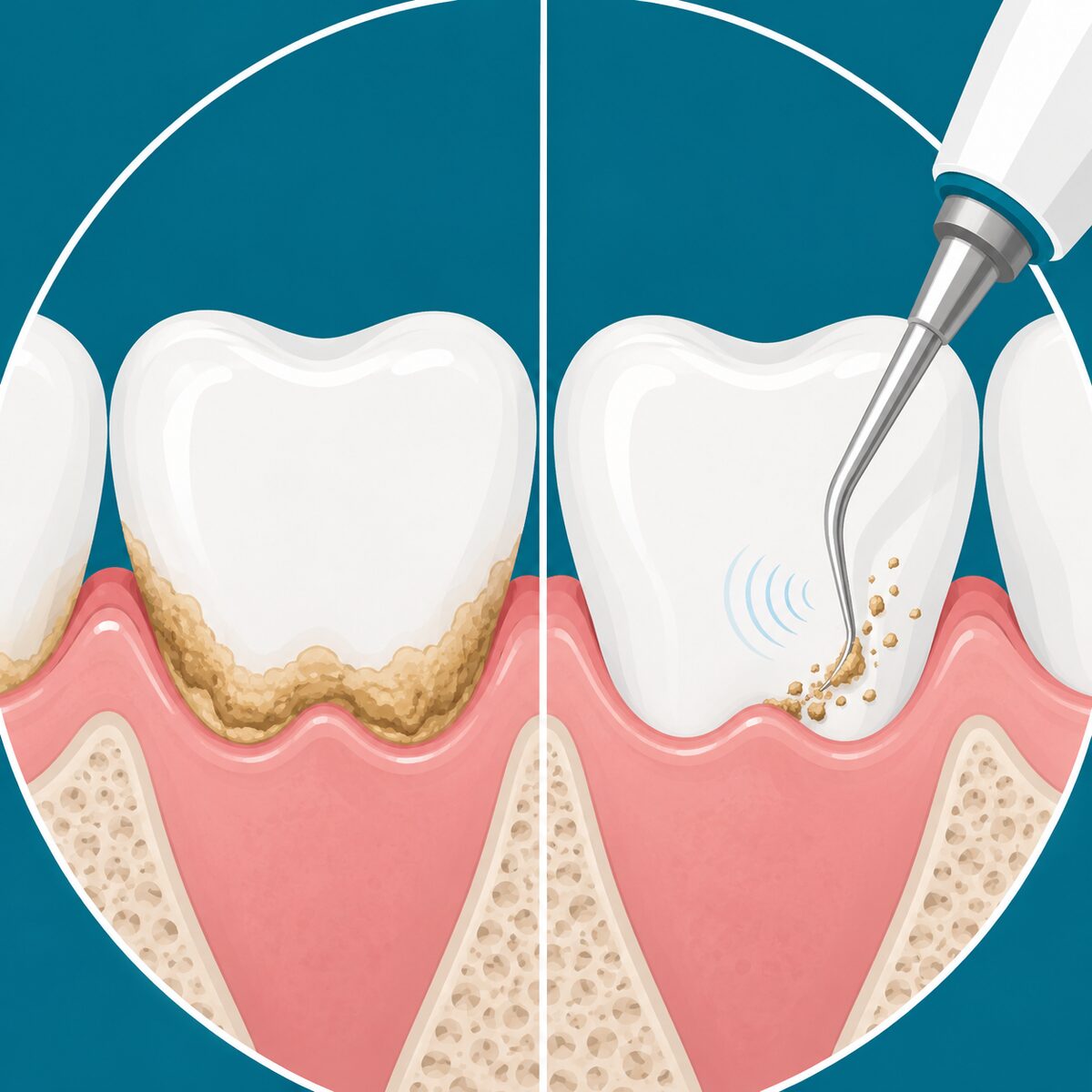
Scaling and root planing is a deep teeth cleaning that goes below the gumline to remove hardened tartar and bacteria your toothbrush can't reach. It's the standard treatment when gum disease has started, and it's how your dentist stops it before it loosens your teeth. Done properly, it lets sore, bleeding gums heal and tighten back around the tooth.
What scaling and root planing means
It's two separate steps. Scaling is removing the hard tartar and plaque stuck on your teeth, both above and below the gumline. Root planing is smoothing the surfaces of the tooth roots so the gum can heal and reattach cleanly, and so bacteria find it harder to cling on again.
Together they're often just called a deep cleaning, and they're a step beyond the regular cleaning you get at a checkup. A normal polish handles the surface. This goes underneath, into the little pockets that form between gum and tooth when gum disease sets in. If your gums bleed when you brush, that's often the early signal, and you can read why in our guide to what causes bleeding gums.
Why you might need it
When plaque isn't cleaned off, it hardens into tartar. Tartar can't be brushed away, and it irritates the gums until they pull away from the teeth, forming pockets. Bacteria thrive in those pockets. Left alone, this leads to bone loss and eventually loose teeth. Scaling and root planing clears those pockets out before that happens.
Signs you might need it: gums that bleed easily, bad breath that won't shift, gums that look red or pulled back, or a dentist telling you your pockets are getting deep. It's common, and catching it at this stage is far better than waiting.
The procedure, step by step
Here's what actually happens in the chair, in order.
Step 1: Numbing the area
Your dentist usually numbs the gums with a local anaesthetic, so you don't feel the cleaning below the gumline. If your case is mild, sometimes only a numbing gel is needed. Either way, you shouldn't feel pain during the cleaning.
Step 2: Scaling away the tartar
Using an ultrasonic scaler (a fine vibrating tip with a water spray) and hand instruments, your dentist removes the tartar from the tooth surfaces and from inside the gum pockets. You'll hear a buzzing and feel some vibration, but with the area numb it shouldn't hurt.
Step 3: Root planing
Next, the root surfaces are smoothed out. A rough root holds bacteria and stops the gum from reattaching. Planing it smooth gives the gum a clean surface to reattach to. This is the part that helps the pockets shrink over the following weeks.
Step 4: Rinsing and sometimes medication
The area is rinsed clean. In some cases your dentist places an antibacterial gel into the pockets or prescribes a medicated mouth rinse to help the gums settle. Depending on how much tartar there is, the whole mouth might be split across 2 visits, often one side at a time.
You can find out more on our periodontal treatment page if you want the clinical detail.
How many visits will I need?
It depends on how much tartar has built up and how deep the pockets are. A mild case might be handled in a single appointment. More widespread gum disease is usually split into 2 or sometimes 4 sittings, treating one quadrant of the mouth at a time so you're not numb everywhere at once and each area gets proper attention. Your dentist decides this after measuring your pockets, and they'll tell you the number of sittings and the cost before starting.
Does it hurt, and what does it cost?
During the procedure, no, because the area is numb. Afterward your gums may feel tender for a day or two and your teeth might be a little sensitive to cold for a short while. That settles. In the Lucknow market, scaling runs roughly ₹1,000 to ₹3,000, and a full deep cleaning with root planing depends on how many areas need treating. You'll get an exact quote after your gums are checked, since severity varies a lot person to person.
Aftercare, so the healing sticks
The cleaning does the hard part, but the weeks after decide how well your gums recover.
- Brush gently twice a day with a soft brush. Don't avoid the treated gums out of fear, just be gentle.
- Floss daily, or use an interdental brush. This is what keeps the pockets from filling up again.
- Rinse with warm salt water for the first few days to soothe the gums.
- Use any medicated rinse your dentist prescribes for the full course.
- Cut back on smoking. Tobacco is one of the biggest drivers of gum disease coming back.
You'll usually come back for a review so your dentist can measure the pockets and check they've shrunk. If your hygiene holds up, the gums tighten, the bleeding stops, and you avoid the far costlier treatments that uncontrolled gum disease leads to. Got more questions? Just get in touch with the clinic.
In short
Scaling and root planing is a deep clean below the gumline that stops gum disease from getting worse. It's numbed, so it doesn't hurt at the time, and recovery is quick with a little tenderness. The real work afterward is yours, daily brushing, flossing, and laying off tobacco keep your gums healed. If your gums bleed or your dentist mentions deep pockets, don't put it off. Get it checked and cleaned early.
Frequently Asked Questions
Does scaling and root planing hurt?
Not during the procedure, because your gums are numbed with a local anaesthetic first. Afterward you might feel some tenderness and short term cold sensitivity for a day or two, which settles on its own. Most people find it far more comfortable than they expected.
How is deep cleaning different from a regular cleaning?
A regular cleaning polishes the visible tooth surfaces above the gumline. Deep cleaning, or scaling and root planing, goes below the gumline into the pockets where tartar and bacteria hide once gum disease starts. It's a treatment, not just routine maintenance.
How much does scaling cost in Lucknow?
Scaling typically runs around ₹1,000 to ₹3,000, and a full deep cleaning with root planing depends on how many areas need work. Because gum disease varies so much between people, you'll get an exact quote after your dentist checks your gums and pocket depths.
Will my gums grow back to normal after this?
The gums can tighten and reattach, and the bleeding usually stops once the pockets are clean and you keep up your home care. Bone that was already lost doesn't grow back, which is why catching gum disease early matters. Daily flossing and regular reviews keep it from returning.