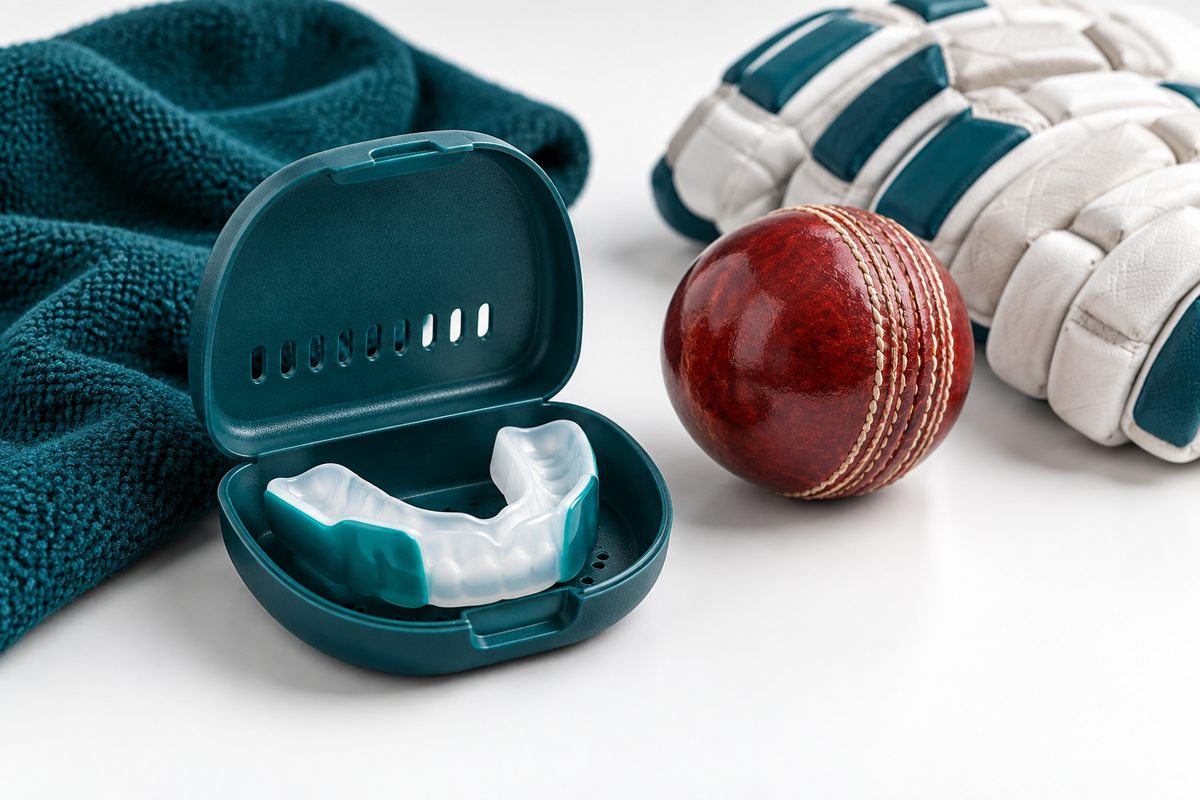
A sports mouthguard helps cushion blows that can chip, loosen or knock out teeth during cricket and other active sports. The best choice is one that fits securely, lets you breathe and speak comfortably, and is worn every time you play.
Why wear a sports mouthguard?
A cricket ball, hockey stick, elbow, shoulder or simple fall can cause a dental injury in seconds. Front teeth are especially exposed. A hard impact may chip a tooth, crack it, loosen it or knock it out completely. Lips and cheeks can also be cut against the teeth.
This is why we recommend a sports mouthguard for activities where there is a realistic chance of contact, a fast-moving ball or a fall. Cricket, hockey, football, basketball, martial arts and skating are common examples.
A mouthguard sits over the teeth and helps absorb and spread some of the force from an impact. It can protect the teeth and the soft tissues inside the mouth, and it may also reduce some injuries to the jaw. It cannot prevent every injury, but it gives your teeth an extra layer of protection.
If you or your child plays regularly, use the guard during practice as well as matches. Many accidental blows happen during training.
Do cricket players really need a mouthguard?
Yes, a mouthguard for cricket is sensible, especially for batters, wicketkeepers and fielders close to the bat. Helmets are very useful, but they do not cover every part of the mouth and jaw.
A ball can still reach the lower face, and collisions can happen while running between wickets or fielding. Younger players may also fall awkwardly while learning. If you want to protect teeth during sports, a well-fitting mouthguard is one of the simplest precautions you can take.
The same idea applies elsewhere. Hockey has sticks, balls and close contact. Football and basketball involve elbows and collisions. Martial arts include direct contact. Skating brings the risk of falling onto a hard surface.
What types of mouthguards are available?
There are three main types. The difference is mostly in fit, comfort and how well the guard stays in place during movement.
| Type | Fit | Comfort and speech | Protection |
|---|---|---|---|
| Stock | One standard shape, often loose | Usually bulky, can make talking and breathing harder | Basic protection, but the loose fit can limit how well it works |
| Boil-and-bite | Softened in hot water and moulded around the teeth | Better than stock, but can still feel thick and may loosen with use | Better protection than stock if moulded properly |
| Custom-made | Made from an impression or digital scan of your teeth | Usually the easiest to wear, speak and breathe with | Best fit and usually the most protective of the three |
Stock mouthguards
Stock guards are ready-made. They are usually the cheapest option, but the fit is often poor because one shape has to suit many mouths. A loose guard may move around while you run, speak or breathe.
Some people end up biting down to keep it in place. If a guard feels so bulky that you keep taking it out, you are less likely to wear it consistently.
Boil-and-bite mouthguards
A boil and bite mouthguard is softened in hot water and then shaped around the teeth. It usually fits better than a stock guard and is easy to buy.
The result depends on how carefully it is moulded. It can still feel thick, and the material may become thinner, stretched or distorted over time. If the guard no longer grips the teeth properly, it should be replaced.
Custom-made mouthguards
A custom mouthguard is made to match your teeth from an impression or digital scan. Because it is shaped for your mouth, it usually stays in place better and feels less bulky.
That can make breathing and speaking easier during active sport. The closer fit also helps the guard spread impact forces more evenly. For people who play regularly, have already had a dental injury or find shop-bought guards uncomfortable, this is often the most practical choice.
At our clinic, custom guards are part of the preventive care we discuss under general dentistry.
What about children whose teeth are still changing?
Children need extra attention because their mouths are still growing. Baby teeth fall out, adult teeth come through, and the shape of the dental arch changes.
A mouthguard that fitted well a few months ago may become tight, loose or uncomfortable later. Check the fit regularly, especially while new adult teeth are erupting.
Do not keep using a guard that rocks, pinches the gums or needs to be forced into place. A growing child may need more frequent replacements than an adult. If your child chews the guard heavily, inspect it often for deep bite marks, thinning or tears.
Can you wear a mouthguard with braces?
Yes, but the guard needs extra room around the brackets and wires. A standard tight-fitting guard may not be suitable because the teeth can move during orthodontic treatment.
A mouthguard with braces is designed to cover the brackets while still allowing for that movement. It also creates a cushion between the braces and the lips or cheeks, which can reduce cuts if there is an impact.
If you or your child is having braces, ask the orthodontist which type of guard is suitable and when it should be replaced. Do not reshape a tight guard over fixed braces without professional advice.
How should you look after a sports mouthguard?
Good care keeps the guard cleaner, helps it keep its shape and makes it easier to spot wear.
- Rinse it with cool or lukewarm water after each use.
- Clean it gently with a soft toothbrush and mild soap.
- Let it dry, then store it in a clean, vented case.
- Keep it away from boiling water, heaters and hot car dashboards because heat can distort it.
- Replace it if it becomes thin, torn, badly chewed, loose or uncomfortable.
It is sensible to bring the guard to routine dental visits from time to time. We can check the fit and look for worn areas that are easy to miss at home.
Do not share a mouthguard with anyone else. It is made for one person's mouth and should be treated like a toothbrush.
What should you do if a tooth is injured during a match?
Stop playing and check the mouth straight away. If there is bleeding, use clean gauze or a clean cloth with gentle pressure. If a tooth is chipped, save any broken piece if you can find it.
If you have a chipped or cracked tooth, even a small break is worth checking because the damage can be deeper than it looks.
A loose permanent tooth also needs prompt dental assessment. Try not to keep touching or wiggling it, and avoid biting on that side until it has been examined.
If a permanent tooth is completely knocked out, act within minutes. Handle it by the crown, not the root, and follow our step-by-step guide for a knocked-out tooth. Fast action can make a real difference to the treatment options.
For heavy bleeding, severe swelling, significant facial injury, trouble breathing, loss of consciousness or other serious symptoms, seek urgent medical care. Our guide to dental emergencies explains which dental problems should be treated without delay.
How often should a mouthguard be replaced?
There is no single replacement schedule that suits everyone. It depends on age, growth, how often you play, the material and how much you chew or grind on the guard.
Adults may use a well-kept guard for longer if the fit remains secure and the material is intact. Children often need changes sooner because their teeth and jaws are developing.
Replace the guard if it becomes loose, cracked, torn, rough at the edges or noticeably thinner in one area. You should also have it checked after major dental work because fillings, crowns or orthodontic changes can alter the fit.
Choosing the right mouthguard
The best guard is one you will actually wear every time you play. It should stay in place without constant biting, feel secure, allow comfortable breathing and not make speech unnecessarily difficult.
For occasional lower-contact activity, a properly fitted boil-and-bite guard may be reasonable. For regular cricket, hockey, martial arts or other higher-risk sport, a custom-made guard offers the closest fit and the most reliable coverage.
If you would like us to check your current guard or make one from an impression or scan, you can book a mouthguard fitting at Haihyvanshi Dental Clinic & Implant Centre on IIM Road, Lucknow.
Frequently Asked Questions
At what age can a child start wearing a sports mouthguard?
A child can wear a sports mouthguard as soon as they are taking part in an activity where a blow or fall could injure the teeth. The main issue is fit. Because children are growing and adult teeth are erupting, the guard should be checked regularly and replaced when it becomes tight, loose or worn.
Is a boil-and-bite mouthguard good enough for cricket?
It can be a reasonable option if it is moulded carefully, stays securely in place and does not interfere too much with breathing or speech. For frequent play, a custom-made guard usually fits more closely and is easier to wear. Any guard that becomes loose, thin or distorted should be replaced.
Can my child wear a normal mouthguard over braces?
A standard close-fitting guard may not leave enough room for brackets, wires and tooth movement. Children with braces usually need a guard designed for orthodontic treatment. It should protect the lips and cheeks from the brackets while allowing the teeth to move. Ask the orthodontist to check the fit as treatment progresses.
What should I do if a permanent tooth is knocked out during sport?
Act quickly. Pick the tooth up by the crown, not the root, and do not scrub it. If possible, follow the steps in our knocked-out tooth guide and contact a dentist straight away. A knocked-out permanent tooth is time-sensitive, so do not wait until the match or practice session is over.