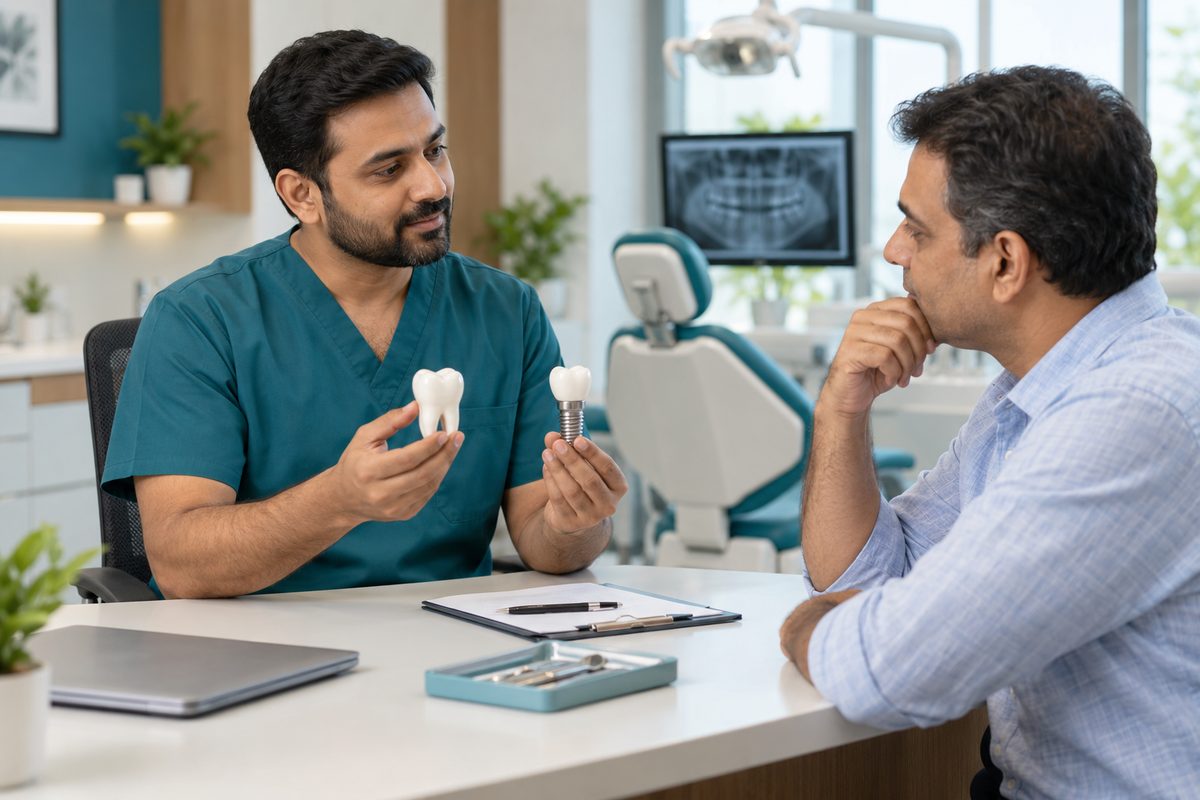
Root canal vs implant decisions come down to one question: can your natural tooth still be restored predictably? If the roots are sound and enough healthy tooth remains, saving it is usually preferred. If the tooth is cracked into the root, badly unsupported or no longer restorable, an implant may be the more sensible option.
Root canal vs implant: which option usually comes first?
If a badly damaged tooth can still be restored with a good long-term outlook, dentists generally prefer to keep it. Your own tooth root helps preserve the surrounding bone, the tooth usually feels natural when you bite, and you avoid replacing it with an artificial root and crown.
That does not mean every tooth should be saved at any cost. Sometimes there is not enough healthy tooth left, the root is cracked, the supporting bone is poor, or previous treatment has not worked. In those situations, extraction followed by an implant may give a more predictable result.
The real question is not simply, "Is implant better than root canal?" It is, "Can this particular tooth be saved predictably?"
When can a damaged tooth still be saved?
A root canal is used when the nerve inside the tooth is badly inflamed, infected or dead, but the tooth itself still has enough sound structure to rebuild. During root canal treatment, the infected tissue is removed from inside the tooth, the canals are cleaned and sealed, and the tooth is restored. Back teeth usually need a crown afterwards because they take heavy chewing forces.
We usually lean towards saving the tooth when there is enough strong tooth above the gum to hold a reliable restoration, the roots are sound, and the gums and bone provide good support.
When is an implant usually the better choice?
An implant starts with removing the tooth. A titanium implant is placed in the jawbone to act as an artificial root, and a crown is attached later. You can read more about how dental implants are planned and restored.
An implant is often considered when a tooth has a crack extending into the root, when very little usable tooth structure remains, when there is severe bone loss around the tooth, or when repeated attempts to save it have failed.
A root fracture is especially important. A crack that runs deep below the gum or down the root usually cannot be predictably repaired. The same applies if the tooth is too weak to support a crown. If the dentist cannot create a stable seal and strong restoration, saving it may only delay removal.
How does a dentist decide if the tooth is restorable?
We look at more than the nerve.
The dentist checks how much healthy tooth remains above the gum, whether decay extends deep below the gumline, whether the root is cracked, how much bone supports the tooth, and whether the tooth is loose. An X-ray helps show the roots, infection around the root tip, bone levels and previous treatment.
If you have been told both options are possible, ask what makes the tooth restorable, what weakens its outlook, and what would happen if the first plan failed. Our guide to root canal or extraction also explains the decision in more detail.
Root canal and crown compared with extraction and implant
| Point | Root canal and crown | Implant |
|---|---|---|
| What happens | Your natural tooth and root are kept. The infected pulp is removed and the tooth is restored. | The tooth is removed and replaced with an implant in the jawbone, followed by a crown. |
| Best suited to | A restorable tooth with sound roots and reasonable gum and bone support. | A tooth that cannot be predictably restored, such as one with a deep root crack or severe structural damage. |
| Treatment time | Often completed over a few weeks, depending on the infection and crown plan. | Often takes several months because healing is needed. It may take longer if bone grafting is required. |
| Bone and sensation | Keeping the natural root helps maintain the surrounding bone and preserves natural biting sensation. | The implant transfers chewing force through bone, but it does not have the same ligament sensation as a natural tooth. |
| Future problems | Decay can develop around a crown margin, and the tooth can fracture or become reinfected. | Gum inflammation and bone loss can occur around an implant, and implant components may need maintenance. |
| Cleaning | Brush carefully, clean between the teeth and attend regular checks. | Brush carefully, clean around the implant and attend regular checks. |
Success rates for both are high in suitable cases, but neither treatment removes the need for careful cleaning and regular dental reviews.
How long does each treatment take?
A root canal and crown can commonly be completed within a few weeks. The exact number of visits depends on the tooth, the infection, whether symptoms settle as expected, and how the final crown is made.
An extraction and implant usually takes longer. Sometimes an implant can be placed at the time of extraction, but that is not suitable for every tooth. In many cases, the area needs healing before or after implant placement. The implant then needs time to integrate with the bone before the final crown is fitted. If a bone graft is needed, the treatment period can be longer.
So if both options are suitable, treatment time may form part of your decision, but it should not override whether the tooth is genuinely restorable.
What if a root canal has already failed?
A previous root canal problem does not automatically mean the tooth must be removed. Some teeth can be treated again if the cause can be identified and corrected. There may be an untreated canal, leakage under an old restoration, or persistent infection around the root.
Our guide to a failed root canal explains when retreatment may be considered and when extraction becomes more reasonable.
Retreatment is less attractive when the tooth has a root fracture, very poor remaining structure, severe bone loss, or repeated infection despite appropriate treatment. If retreatment has already failed and the tooth no longer has a predictable restorative plan, extraction and implant treatment may be the better choice.
Is an implant better than a root canal?
Not automatically.
An implant is an excellent tooth replacement option when a tooth cannot be saved, but it is still a replacement for a natural tooth. It needs healthy gums, adequate bone, careful cleaning and long-term follow-up.
A successfully treated natural tooth has advantages that an implant does not fully copy. You keep your own root, natural ligament and normal tooth-to-bone relationship. On the other hand, keeping a tooth that is cracked beyond repair or too weak to restore does not become a good plan simply because it is natural.
That is why the answer to "save tooth or implant" depends on the condition of that individual tooth.
What about cost?
Cost matters, but it should not be the only deciding factor. A cheaper first step is not good value if the tooth has a poor outlook, and removing a restorable tooth simply to avoid future dental work can create unnecessary treatment.
Our implant cost guide gives treatment ranges and explains what can affect the final amount. Cost guides are useful for planning, but they cannot tell you which option is right for your tooth.
An examination and an X-ray are what allow the dentist to judge the remaining tooth structure, root condition, bone support and likely treatment needs.
What should you do if you have been given both options?
Ask your dentist to show you the X-ray and explain why the tooth can or cannot be restored. You should understand how much healthy tooth remains, whether there is a crack, what condition the roots and bone are in, whether a crown will have enough support, and what the backup plan would be if treatment fails.
If the tooth has a reasonable chance of being restored and maintained, saving it is usually the first consideration. If the tooth is structurally hopeless, has severe loss of support, or has failed despite appropriate retreatment, replacing it may make more sense.
If you are unsure which route fits your tooth, you can book an assessment with Haihyvanshi Dental Clinic & Implant Centre on IIM Road, Lucknow. Bring any recent X-rays or treatment records you already have so we can review them with you.
Frequently Asked Questions
Can a badly broken tooth still be saved with a root canal?
Sometimes, yes. The deciding factor is not how dramatic the tooth looks, but how much sound structure remains, where the damage ends, whether the root is intact, and how well the tooth is supported by gum and bone. An examination and X-ray are needed before deciding if a crown can restore it reliably.
If a root canal fails, do I have to get an implant?
No. Some failed root canal teeth can be retreated if the cause can be corrected and the tooth is still structurally sound. Extraction and implant treatment becomes more reasonable when there is a root fracture, severe bone loss, too little tooth left to restore, or persistent problems despite appropriate retreatment.
Is an implant stronger than a root canal treated tooth?
They are different treatments, so strength alone is not a useful comparison. A well-restored root canal tooth can function well when enough healthy structure remains. An implant can also function well when properly planned and maintained. The better option depends on the condition of the tooth, roots, gums, bone and bite.
How soon can an implant be placed after extraction?
Sometimes an implant can be placed at the same visit as the extraction, but not every site is suitable. In other cases, the area is allowed to heal first. Infection, bone quantity, gum condition and the need for grafting all affect timing. Your dentist can estimate the sequence after examining the tooth and X-ray.