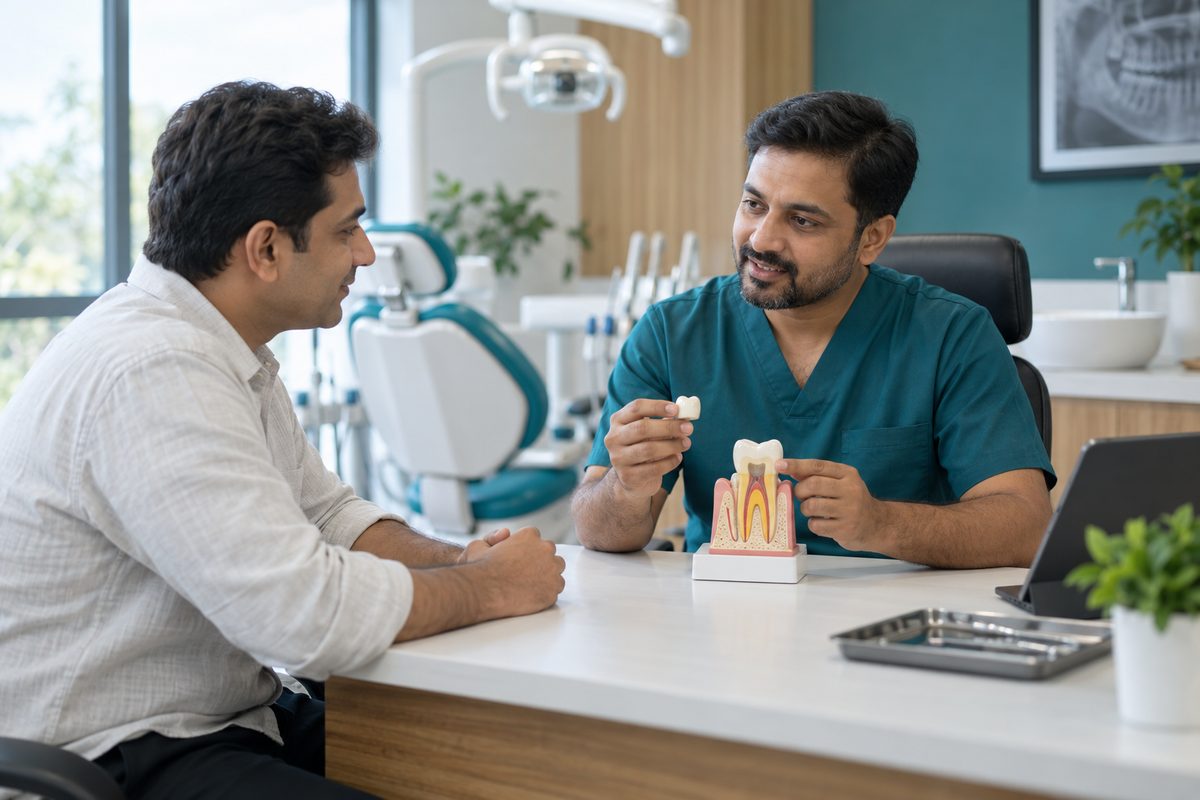
A crown after root canal treatment is usually recommended for molars and premolars because these teeth take heavy chewing forces. Some front teeth can be restored with a filling if plenty of strong natural tooth remains. The right choice depends on the tooth, how much structure is left and your bite.
Is a crown necessary after a root canal?
Not every root canal tooth needs a crown, but many do. The answer depends mainly on which tooth was treated and how much healthy tooth structure is still left.
During root canal treatment, the pulp inside the tooth is removed, including its nerve and blood supply. The bigger reason a treated tooth is more likely to fracture, though, is usually the tooth structure already lost to decay, a large old filling, a crack, or the opening made to reach the canals.
A tooth can feel completely comfortable after treatment and still be mechanically weak. Pain relief tells us the infection or inflammation has been treated. It doesn't tell us how strong the remaining tooth is.
That is why we judge the need for a crown after root canal by looking at the tooth itself, not by following one rule for every patient.
Which teeth usually need a crown?
Back teeth do most of the heavy chewing. Molars and premolars take repeated pressure from food, clenching and grinding, so they usually benefit from being covered with a crown after RCT.
Front teeth are different. If an incisor or canine had a small access opening and most of the natural tooth is still strong, a bonded filling may sometimes be enough. If a front tooth has a large filling, crack, heavy bite, or major loss of structure, a crown may still be advised.
| Tooth | Crown usually needed? | Why |
|---|---|---|
| Molar | Yes, in most cases | It takes high chewing forces and often has a lot of structure missing |
| Premolar | Often yes | Its cusps can split under biting pressure, especially after a large filling or decay |
| Incisor | Sometimes | A filling may be enough if most of the tooth is intact and the bite is favourable |
| Canine | Sometimes | The decision depends on remaining structure, bite forces and previous damage |
So if you're asking "is crown necessary after root canal?", the more useful question is how much strong tooth is left and how much load that tooth carries.
What happens if you skip the crown?
A root canal without crown protection can sometimes last, especially in a front tooth with plenty of healthy structure. The risk is higher in back teeth.
The main concern is fracture. A weakened molar or premolar can crack while you're chewing something quite ordinary. Some cracks can be repaired. Others run below the gum or into the root, and then the tooth may no longer be restorable.
The second concern is leakage. The filling placed after root canal treatment has to keep saliva and bacteria out of the cleaned canals. If it breaks, wears down or develops a gap, bacteria can enter again. That can cause reinfection and may mean retreatment or extraction.
If you're deciding between preserving a damaged tooth and removing it, our guide to root canal or extraction explains how dentists compare those options.
Skipping a cap after RCT isn't automatically a problem in every tooth. But where a crown has been recommended because the tooth is weak, delaying it means accepting a higher risk of a fracture that may be much harder to fix.
How soon should you get a crown after root canal?
In many cases, the final crown is planned within a few weeks of finishing the root canal, once the tooth is comfortable and your dentist is satisfied with the treatment.
The exact timing can vary. Sometimes we allow a short period for symptoms to settle. If the tooth is badly weakened, we usually prefer to restore it sooner so it isn't left under chewing pressure for long.
Until the final restoration is fitted, avoid using that tooth to bite very hard foods. A temporary filling seals the tooth, but it doesn't give the same protection as a properly fitted final crown.
If the temporary filling breaks, the tooth feels different when you bite, or part of the tooth chips away, contact your dentist rather than waiting for the next planned visit.
For most weakened back teeth, the practical answer to "how soon crown after root canal?" is within weeks, not after several unprotected months, unless your dentist has a reason to wait.
Do you need a post and core first?
Sometimes there isn't enough tooth left to support a crown directly. A core build-up is then used to replace the missing central part of the tooth.
A post may be placed inside one of the treated root canals when extra retention is needed for the core. A post doesn't strengthen the root itself. Its main job is to help hold the build-up when little natural crown structure remains.
Not every root canal tooth needs a post. If enough sound tooth is present, adding one may offer no benefit.
What does getting the crown involve?
For a routine crown, the tooth is shaped so the restoration can fit over it. If a core build-up is needed, that is completed first.
An impression or digital scan is then taken to record the prepared tooth and your bite. A temporary crown may be placed while the final crown is being made.
At the fitting visit, the dentist checks the crown's fit, contact with neighbouring teeth, bite and appearance. It is then fixed in place if everything is satisfactory.
You can read more about the process on our crowns and bridges page.
What types of dental crowns can be used after RCT?
There isn't one material that is best for every tooth. The choice depends on tooth position, bite, available space, appearance and how much natural tooth remains.
Metal crowns are strong and require relatively little tooth reduction, but they are visibly metallic.
Porcelain fused to metal crowns combine a metal base with a tooth-coloured outer layer. They can work well, though the porcelain can chip and a dark metal edge may become visible near the gum in some cases.
Zirconia crowns are strong and tooth-coloured, and they are commonly used for back teeth as well as many visible areas. Different zirconia formulations vary in strength and translucency. Our guide to zirconia crowns explains those differences.
All-ceramic crowns can give natural colour and translucency, which can be useful for front teeth. Their suitability for a heavily loaded back tooth depends on the ceramic material, your bite and the amount of tooth remaining.
If cost is part of your decision, use our crown cost guide to understand what changes the fee rather than choosing only by material name.
A crown doesn't fix a poor root canal
A crown protects the remaining tooth structure, but it cannot correct an untreated canal, a root fracture or ongoing infection.
Before covering the tooth, the dentist should be satisfied that the root canal is acceptable and that the tooth can be restored. Persistent swelling, a gum boil or significant tenderness should be assessed before the final crown is placed.
There are also common misunderstandings about what root canal treatment does to a tooth. Our article on root canal myths covers them.
How do we decide what your tooth needs?
We look at how much natural tooth is left, whether it has cracks, where it sits in your bite, the size of any old filling, and how much chewing force it receives. X-rays may also be needed to review the root canal and surrounding bone.
We often see patients in Lucknow who feel well after RCT and assume the treatment is completely finished. Sometimes it is. In many back teeth, the root canal has treated the inside and the crown is the part that protects the outside from fracture.
If you've had a root canal and aren't sure whether a filling is enough, bring the X-ray and treatment details if you have them. You can book a consultation with Haihyvanshi Dental Clinic & Implant Centre on IIM Road so we can assess the remaining tooth before you decide.
Frequently Asked Questions
Can I chew on a root canal tooth before the crown?
If the tooth is waiting for a crown, try not to chew hard or sticky foods on that side. A temporary filling or temporary crown protects the tooth but is not as strong as the final restoration. If the temporary material comes out or the tooth chips, contact your dentist promptly.
Can a filling be enough after RCT?
Yes, sometimes. A front tooth that has lost very little structure and has a favourable bite may be restored with a bonded filling. Back teeth usually need more protection because they take heavier chewing forces. Your dentist has to judge the amount of healthy tooth left before recommending one or the other.
Does every root canal tooth need a post before a crown?
No. A post is usually considered only when too little natural tooth remains to hold the core and crown securely. It sits inside a treated canal to provide retention for the build-up. It does not strengthen the root itself, and placing one when it is not needed offers no clear advantage.
What if my root canal tooth has been without a crown for months?
It should be checked before a crown is made. The dentist may look for cracks, leakage, recurrent decay, tenderness and changes around the root on an X-ray. If the tooth is still sound and the root canal is satisfactory, it may still be restorable. Avoid hard chewing on it until it is assessed.