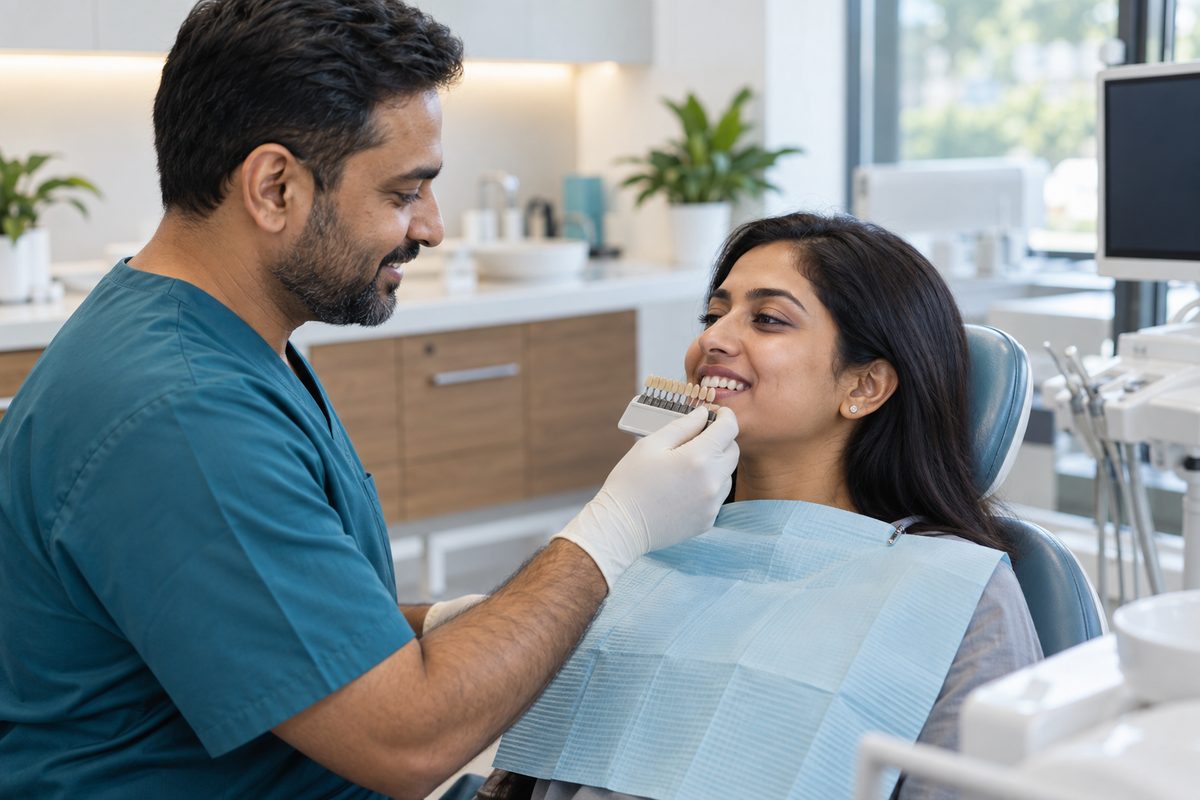
Dental crown procedure appointments usually take two visits: one to prepare the tooth and fit a temporary crown, and another to check and cement the final crown. The tooth is numbed for shaping, and most people can expect only mild short-term sensitivity afterwards.
Why would a dentist advise a crown?
A dental crown, often called a cap, covers the visible part of a tooth and helps restore its shape, strength and function. We may advise one when a tooth is heavily filled, broken, cracked or badly worn, or when there is not enough healthy tooth left for another filling.
Crowns are also commonly used after root canal treatment because the tooth may be more prone to fracture, especially at the back of the mouth. If that is your situation, our guide to a crown after a root canal explains why timing and remaining tooth structure matter.
A crown may also form the visible tooth on top of a dental implant. In that case, the natural tooth is not shaped because it has already been replaced by the implant.
If an old filling keeps breaking, it can help to understand why fillings fail before deciding whether another filling or a crown is more suitable.
How many crown fitting visits are usually needed?
For a conventional laboratory-made crown, most people need two main crown fitting visits. The laboratory work between them usually takes about one to two weeks.
| Visit | What happens | How long it takes |
|---|---|---|
| Visit 1 | Examination, local anaesthetic, tooth shaping, impression or digital scan, shade matching and temporary crown | Usually about 1 hour |
| Visit 2 | Temporary crown removal, fit and bite checks, shade check, adjustments and final cementation | Usually 30 to 45 minutes |
These times are a guide. A tooth with a large old filling, fracture or need for rebuilding may take longer. Some clinics also offer same-day milled crowns in selected cases, where scanning, milling and fitting may be completed in one appointment.
What happens at the first visit?
Before we start the dental crown procedure, we check the tooth, the surrounding gum and your bite. An X-ray may be needed to assess the root, an old root canal, decay under a filling or the bone around the tooth.
Local anaesthetic is then used to numb the area. Once the tooth is numb, we shape it so the crown has enough space to fit over it properly. The amount removed depends on the tooth, the material chosen and how much sound tooth structure remains.
If the tooth has lost a large amount of structure, it may first need a core build-up. This creates a stable shape for the crown to sit on. Any active decay or other treatable problem needs to be dealt with before the final crown is fitted.
After shaping, we take either a traditional impression or a digital scan. This records the prepared tooth, neighbouring teeth and the way your upper and lower teeth meet. The laboratory uses this information to make the final crown.
We also select the shade, especially for a visible tooth. At the end of the visit, a temporary crown is fitted over the prepared tooth to protect it while the final crown is being made.
Does a crown hurt?
During tooth shaping, the area is numbed with local anaesthetic, so you should not feel the drilling as pain. You may still notice pressure, vibration or water during the appointment.
After the anaesthetic wears off, mild sensitivity or gum soreness can happen for a few days. A tooth that still has a living nerve may be more sensitive to cold for a short time. Pain that is strong, worsening, spontaneous or keeping you awake needs a review.
Sometimes the crown or temporary crown feels slightly high when you bite. A small bite adjustment can often correct this.
How should you look after a temporary crown?
Temporary crown care matters because the temporary is held with a weaker cement so it can be removed at the next visit.
Avoid very sticky foods, hard sweets, nuts, ice and tough food on that side. Brush the area gently but thoroughly. You can floss around the temporary, but instead of pulling the floss straight up through the contact, slide it out to the side. This reduces the chance of lifting the temporary crown.
If the temporary crown comes off, keep it safely and call the clinic. Try not to leave the prepared tooth uncovered for several days because it may become sensitive and nearby teeth can shift slightly.
What happens between the two visits?
The laboratory makes the final crown from the impression or scan. This usually takes about a week or two, depending on the material and laboratory schedule.
During this time, your temporary crown acts as a short-term cover. If it feels rough, loose or uncomfortable, let us know rather than waiting for the fitting appointment.
What happens at the second visit?
At the second appointment, we remove the temporary crown and clean the prepared tooth. We then place the final crown without permanently cementing it at first.
We check that it sits fully, that the edge fits closely, that the contact with neighbouring teeth allows flossing, and that your bite feels natural. For a visible tooth, we also check the shade and shape.
Small adjustments can often be made in the clinic. If the fit or shade is not acceptable, it may be better to send the crown back to the laboratory before it is cemented.
Once the crown and bite are satisfactory, the crown is cemented or bonded in place, depending on the material and clinical situation. Excess cement is removed, and we check the bite again before you leave.
You can read more about the treatment options on our crowns and bridges page.
Which crown material might be used?
Common materials include zirconia, porcelain or ceramic, porcelain fused to metal, and full metal crowns. The choice depends on the tooth position, biting forces, available space, appearance and the condition of the remaining tooth. Our guide to zirconia crowns explains where zirconia may be useful and what its limitations are.
What should you expect after the final crown is fitted?
Your mouth may feel different for the first day because the tooth has a new shape and contact. Mild gum tenderness or temperature sensitivity can occur for a few days.
Brush the crown as you brush your other teeth and floss around it every day. The crown itself cannot decay, but the natural tooth at the crown edge can. Plaque around that margin can also irritate the gum.
Avoid chewing supari, biting ice, opening packets with your teeth or chewing pens. If you grind or clench your teeth at night, a night guard may help protect the crown and your other teeth.
If the bite feels high after the numbness has completely worn off, arrange a check. A crown that hits first every time you close can make the tooth sore.
When should you call the dentist after crown fitting?
Contact the clinic if the crown becomes loose, comes off, cracks, feels persistently high, or if you develop increasing pain, swelling or pain on biting. Sensitivity that does not settle also deserves a review.
A crowned tooth can still develop problems later, including decay at the edge, gum disease, fracture of the underlying tooth or trouble with the nerve. Regular dental checks help us spot these changes earlier.
How much does a crown cost?
The fee depends on the material used, the condition of the tooth and whether any rebuilding or other treatment is needed before the crown is made. We explain the main factors in our crown cost guide.
If you have been advised a crown or cap for tooth protection and want to know what your own treatment would involve, you can book a crown consultation at Haihyvanshi Dental Clinic & Implant Centre on IIM Road, Lucknow.
Frequently Asked Questions
How long after a crown can I eat normally?
After final cementation, follow the timing your dentist gives you because the cement or bonding system may affect when you can chew. Once cleared, start normally but avoid testing the new crown with very hard foods. If the tooth is still numb, wait before chewing so you do not accidentally bite your cheek or tongue.
What if my temporary crown falls off at night?
Keep the temporary crown safe and avoid chewing on that tooth. Do not try to permanently glue it back with household adhesive. Contact the clinic when it opens so the tooth can be checked and the temporary refitted or replaced. If there is severe pain, swelling or trauma, seek dental advice sooner.
Can a crown be fitted without a root canal?
Yes. Many teeth receive crowns without root canal treatment. If the nerve is healthy and there is enough sound tooth structure, a crown may be placed after shaping the tooth. A root canal is considered only when the nerve is irreversibly inflamed, infected, already treated, or another specific problem makes it necessary.
Why does my new crown feel high when I bite?
A new crown can sometimes contact the opposing tooth slightly earlier than the rest of your bite. Once the anaesthetic has worn off, this may feel obvious during chewing. If the crown still feels high, arrange a review. A small bite adjustment is often enough, and you should not keep chewing through persistent discomfort.