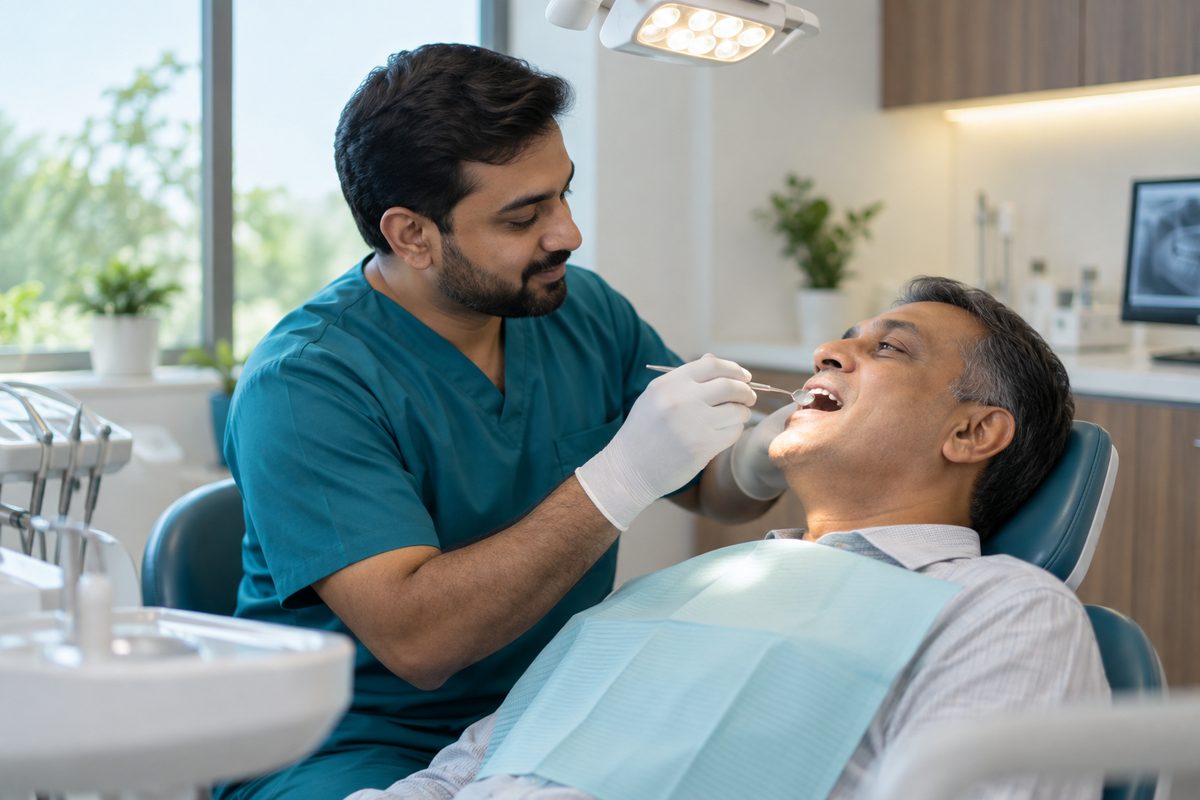
Pyorrhea treatment depends on how far the gum infection has spread and how much support around the teeth has been lost. Early gum disease can often be reversed, while periodontitis usually needs professional treatment and long-term maintenance.
What is pyorrhea?
Pyorrhea is the common Indian name for periodontitis, an infection that affects the gums and the bone that holds your teeth in place. It usually begins with gingivitis, where the gums become red, swollen or bleed during brushing. Gingivitis is reversible when plaque and tartar are removed and daily cleaning improves.
If gingivitis is left untreated, the infection can move deeper below the gum line. The gums may pull away from the teeth, forming pockets where bacteria collect. Over time, the bone supporting the teeth can be damaged. This is when gum disease becomes periodontitis.
The difficult part is that periodontitis can progress with little or no pain. Many people wait because nothing hurts badly. By the time they notice movement in a tooth, pus or a change in the bite, the disease may already be advanced.
What are the common pyorrhea symptoms?
Pyorrhea symptoms can be mild at first and become more obvious as the disease progresses. Watch for bleeding while brushing, persistent bad breath, a bad taste in the mouth, swollen gums, gums that are pulling back, and teeth that look longer than before.
You may also notice bleeding gums that keep returning even after you improve brushing. Other warning signs include pus in gums, new gaps between teeth, food getting stuck more often, sensitivity near the roots, and bleeding and loose teeth.
A changing bite is another sign. Your teeth may not meet in the same way when you close your mouth, or a denture may begin to fit differently. If the gums are shrinking, our guide to receding gums explains why that happens and what can be treated.
Why does pyorrhea happen?
The main cause is plaque, the sticky bacterial film that builds up on teeth. If plaque is not removed well, it hardens into tartar. Tartar cannot be brushed away at home. It gives bacteria a rough surface to collect on and keeps the gums inflamed.
Some factors make gum disease more likely to start or progress. Smoking and chewing tobacco reduce gum healing and can hide bleeding. Diabetes can make gum infections harder to control, especially when blood sugar is high. The connection works both ways, which is why we often discuss diabetes and gum disease together.
Stress, some medicines, family history and crowded teeth can also play a part. Medicines that cause dry mouth or gum overgrowth can make cleaning more difficult. Crowded teeth are not a direct cause by themselves, but they can create areas where plaque is harder to remove.
What are the gum disease stages?
The stage matters because pyorrhea treatment is not the same for every patient.
| Stage | What you notice | What treatment usually involves |
|---|---|---|
| Gingivitis | Bleeding, redness, swelling, bad breath, usually no bone loss | Professional cleaning, better brushing and cleaning between teeth |
| Early periodontitis | Bleeding, mild gum recession, early pocketing, possible early bone loss | Scaling, root surface cleaning and close review of gum pockets |
| Moderate periodontitis | Deeper pockets, more recession, food trapping, some tooth movement | Deep cleaning, local medicines where needed, repeated periodontal review |
| Advanced periodontitis | Loose teeth, larger gaps, pus, bite changes, significant support loss | Advanced gum procedures, possible flap surgery or regenerative treatment, splinting, and extraction only if a tooth cannot be saved |
The exact stage is judged after examining the gums, measuring pocket depths and checking bone levels on dental X-rays. Two people can have similar bleeding but very different amounts of bone loss, so treatment should not be decided from symptoms alone.
How is pyorrhea treatment done?
Treatment starts with removing the bacterial deposits that are keeping the gums inflamed. For mild disease, a professional cleaning may be enough. Once infection has moved below the gum line, the dentist may recommend scaling and root planing. This cleans deposits from below the gums and smooths contaminated root surfaces so the tissues have a better chance to settle.
For some areas, antimicrobial rinses or medicines placed into deeper gum pockets may be useful. These are not a replacement for cleaning. Antibiotics are not automatically required for every case of periodontitis.
After the first phase, the gums are reviewed. If deep pockets remain, surgery may be considered. Flap surgery allows access to areas that cannot be cleaned properly from the surface. In selected defects, regenerative procedures may be used to try to rebuild some lost support. The amount of regeneration possible depends on the shape of the bone defect and the condition of the tooth.
Loose teeth can sometimes be joined to stronger neighbouring teeth with a splint while the gums are treated. Splinting does not cure infection, but it can reduce movement in suitable cases. Extraction is considered only when a tooth has lost so much support that keeping it is not predictable or useful.
You can read more about the types of gum treatment we use for different stages.
Can lost bone grow back after treatment?
Bone lost to periodontitis does not fully grow back on its own. That is why early treatment matters. The main aim of periodontitis treatment is to stop further destruction, reduce inflammation, make the mouth easier to clean and keep useful teeth for as long as possible.
Some advanced procedures can encourage regeneration in carefully selected areas, but results vary. A dentist needs to assess the tooth, the remaining bone, pocket depth, smoking status, blood sugar control and how well the area can be kept clean.
It is also normal for gums to look slightly more receded after inflammation settles. Swollen gums shrink as they become healthier, which can make teeth look longer even though the infection is improving.
What should you do at home after treatment?
Home care decides how well gum treatment holds up between visits. The basics are simple, but they need to be done every day.
- Brush twice daily with a soft-bristle toothbrush and clean between the teeth every day with floss or interdental brushes. Stop smoking or chewing tobacco, keep diabetes under good control, and use any prescribed rinse only for the period advised by your dentist.
Do not depend on herbal powders, salt, clove oil or home remedies to cure pyorrhea. Warm salt water may soothe irritated gums for a short time, but it cannot remove tartar from below the gum line or treat bone loss.
How often do you need maintenance after pyorrhea treatment?
For many people with periodontitis, maintenance visits every 3 to 6 months are just as important as the first treatment. The exact interval depends on pocket depth, bleeding, smoking, diabetes, how quickly tartar returns and how well you can clean at home.
At these visits, we check whether the gums are bleeding again, whether pockets are getting deeper and whether any teeth are becoming more mobile. Areas that are hard to reach can be cleaned before the disease gains ground again.
If you have already had deep cleaning, don't assume the problem is finished because the bleeding has stopped. Periodontitis is a condition that usually needs ongoing monitoring.
When should you see a dentist soon?
Arrange a gum check if you have pus coming from the gums, a tooth that has started to feel loose, swelling that keeps returning, a sudden change in your bite, or bleeding that continues despite careful brushing.
You should also get checked if bad breath is persistent and you can see tartar around the teeth. The earlier we find active disease, the more options there usually are for keeping the teeth.
If you want an assessment, you can book a gum check at Haihyvanshi Dental Clinic & Implant Centre on IIM Road.
Frequently Asked Questions
Can pyorrhea be cured completely?
Gingivitis can often be reversed, but established periodontitis is usually managed rather than described as completely cured. Treatment can control infection, reduce inflammation and help you keep your teeth. Because the disease can return if plaque builds up again, regular maintenance and good home cleaning remain necessary.
Can loose teeth become firm again after pyorrhea treatment?
Some loose teeth become more stable once inflammation is controlled and the bite is managed. Others stay mobile because bone support has already been lost. Splinting may help selected teeth. A dentist needs to check the amount of remaining bone before saying whether a loose tooth can be kept.
Is deep cleaning always needed for pyorrhea?
Not always. Gingivitis may improve with routine professional cleaning and better home care. If there are deeper gum pockets or deposits below the gum line, scaling and root planing is usually more suitable. The choice depends on pocket depth, bleeding, tartar and bone loss seen during examination.
Does pyorrhea cause pus from the gums?
It can. Pus may appear when a deep gum pocket becomes infected or when a periodontal abscess develops. Do not squeeze the gum or rely on home remedies. If you see pus, especially with swelling, pain, fever or a loose tooth, arrange a dental assessment soon.