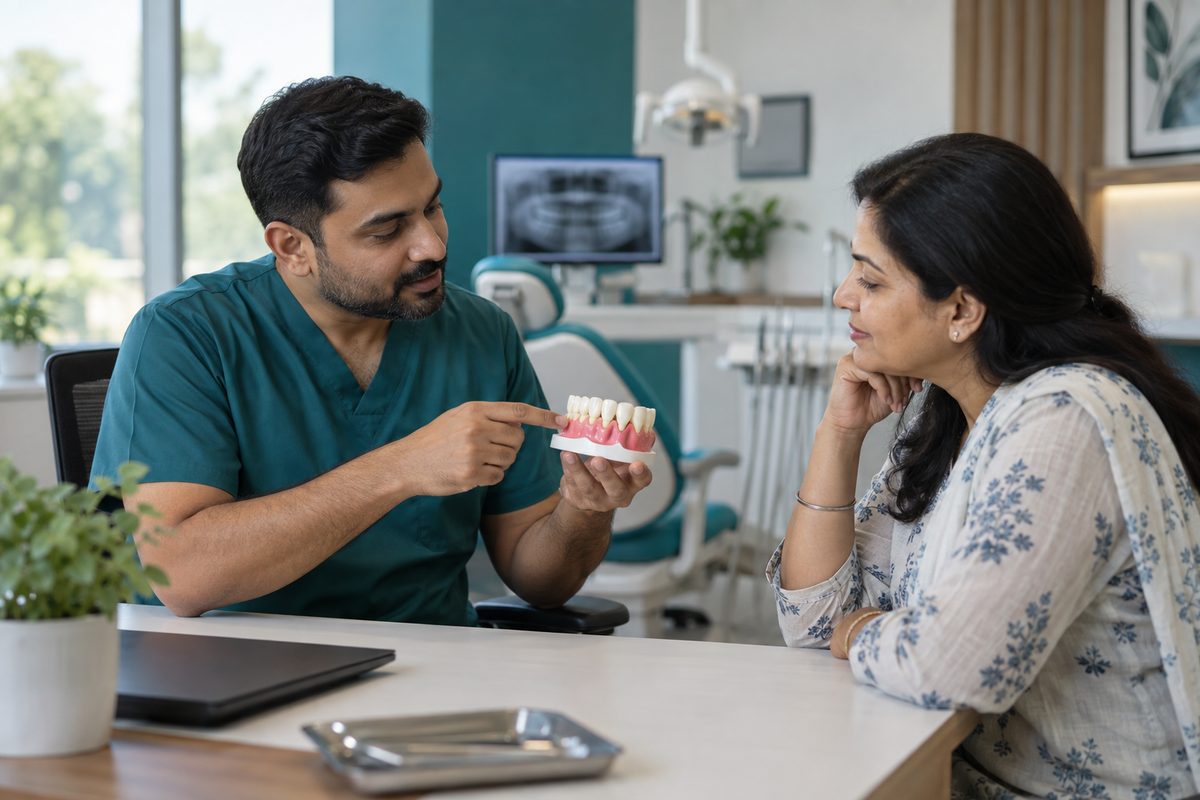
Receding gums happen when the gum edge moves away from its normal position and exposes part of the tooth root. They don't usually grow back on their own, but treating the cause can help stop further recession, reduce sensitivity and, in selected cases, a gum graft may cover the exposed root.
What are receding gums?
Receding gums mean the edge of the gum has moved away from its normal position on the tooth, exposing part of the root surface. In our Lucknow clinic, people often notice this first because one tooth suddenly looks longer than the others, or because cold water starts causing a sharp sensation near the gum line.
The root is not covered with the same hard enamel that protects the crown of the tooth. Once it is exposed, it can be more sensitive and more vulnerable to wear and decay.
You may also see a small notch or step where the gum used to sit. In some areas, food may start getting trapped more easily. Between teeth, recession and loss of supporting gum tissue can create small dark triangles that were not visible before.
If you also have redness, swelling or bleeding gums, don't assume the problem is only cosmetic. It may be a sign of gum disease.
Why do gums pull back?
There isn't one single reason. Sometimes two or three factors are acting together.
| Cause | How it causes recession | What helps |
|---|---|---|
| Gum disease | Inflammation damages the tissues and bone that support the teeth, so the gum margin can move down | Professional assessment, cleaning and, when needed, deep cleaning |
| Brushing too hard | A hard brush, heavy pressure or repeated sideways scrubbing can wear the gum edge and root surface | Soft toothbrush, lighter pressure and better brushing technique |
| Tobacco and gutkha | Tobacco irritates the tissues, and gutkha kept repeatedly in one spot can damage the nearby gum | Stopping the habit and checking the affected area |
| Teeth grinding | Heavy repeated forces can contribute to wear around the gum line, especially when other risk factors are present | Bite assessment and a night guard when appropriate |
| Crooked teeth or thin gums | Teeth that sit outside the thicker part of the bone may have less gum support, especially if the gum tissue is naturally thin | Monitoring, gentle cleaning and specialist assessment if recession progresses |
| Orthodontic tooth movement | In some cases, moving a tooth through a thin bony area can leave the gum more prone to recession | Orthodontic and gum assessment before deciding on treatment |
| Denture or clasp pressure | A partial denture edge or clasp that repeatedly presses on the gum can cause local irritation and recession | Adjustment, replacement or redesign of the denture |
Gum disease is the most common of the gum recession causes we look for because the treatment is different from recession caused mainly by brushing. If there is active gum disease, changing your toothbrush alone won't solve the underlying problem.
Brushing damage is also common. Many people think harder brushing means cleaner teeth. It doesn't. Repeated scrubbing, especially with a hard brush, can injure the gum edge and wear a groove into the exposed root. Our guide to common brushing mistakes explains what to change.
Diabetes can also make gum disease harder to control in some people. If that applies to you, read about diabetes and gum disease and make sure both your dental care and blood sugar management are being followed properly.
What are the early signs of gum recession?
Early recession can be easy to miss because it often develops slowly. You may not have pain.
Common signs include:
- one or more teeth looking longer than before
- a visible notch or step at the gum line
- sensitivity to cold air, cold water or sweet foods
- food trapping near the gum
- small dark triangles appearing between teeth
- a yellowish area near the gum line where the root is exposed
Sensitivity is especially common because an exposed tooth root has tiny channels that can transmit temperature changes towards the nerve. If cold drinks are bothering you, our page on sensitive teeth explains other possible causes too.
Can receding gums grow back?
This is one of the first questions people ask us.
The honest answer is no, gum tissue that has been lost usually does not grow back by itself. A toothpaste, mouthwash or home remedy cannot rebuild the missing gum edge.
That does not mean nothing can be done. In many cases, treatment can stop or slow further recession by dealing with the cause. If the exposed root is sensitive, we can often make it more comfortable. If there is a notch at the gum line, a tooth-coloured filling may protect the worn area.
For selected cases, gum grafting can cover part or sometimes most of an exposed root. The result depends on the position of the tooth, the amount of bone and gum support, the size of the recession, smoking or tobacco habits, and how well the area can be kept clean. A graft should be discussed only after the cause of the recession has been assessed.
How are receding gums treated?
Treatment depends on why the gum has moved. There is no single treatment for receding gums that suits every patient.
If gum disease is present, the first step is usually professional cleaning. When there are deeper gum pockets or deposits below the gum line, scaling and root planing may be advised. Our gum treatment page explains how we manage gum problems based on their severity.
If brushing trauma is the main issue, we focus on a soft brush, lighter pressure and a less aggressive technique. An electric toothbrush with a pressure warning can help some people, but it still needs to be used gently.
For sensitivity, desensitising toothpaste may reduce symptoms over time. Fluoride varnish can also be used in the clinic on an exposed tooth root. If there is a deeper worn notch, a tooth-coloured filling may be useful to protect the surface.
If grinding is contributing, a night guard may be considered after checking your bite and the pattern of tooth wear. If a partial denture or clasp is pressing on the gum, it needs adjustment rather than simply applying gel to the sore area.
Gum grafting is reserved for selected situations. It may be considered if recession is progressing, sensitivity is difficult to control, the root is at risk, or the gum is very thin in an area that needs more protection. Not every exposed root can be fully covered.
Why shouldn't I ignore an exposed tooth root?
An exposed tooth root is softer than enamel and can decay more easily. It can also wear down from aggressive brushing.
Sensitivity may become more noticeable with time, especially with cold water or air. Food trapping can also make cleaning awkward.
If recession is linked to gum disease and bone loss, the bigger concern is the support around the tooth. As bone support reduces, teeth can eventually become mobile. That is why we don't judge recession only by how it looks.
At the clinic, we check the gum level, bleeding, pocket depth, tooth mobility, bite and the condition of the exposed root before suggesting treatment.
What can I do at home to protect my gums?
Use a soft toothbrush and brush with light pressure. Don't saw hard from side to side at the gum line. Angle the bristles gently towards the gum edge and take your time.
Clean between your teeth every day with floss or an interdental brush that fits comfortably. If something repeatedly gets stuck in the same place, don't force a thick brush into the gap. Ask us which size is right.
Avoid gutkha and tobacco, especially placing it repeatedly against one area of gum. If you grind your teeth, mention jaw tightness, morning headaches or visible tooth wear during your dental visit.
Desensitising toothpaste can help an exposed root, but don't expect it to regrow gum. Also, don't stop brushing a sensitive area completely. Plaque left there can make the gum problem worse.
An early gum check is usually much simpler than waiting until recession has progressed. If you've noticed a tooth looking longer, repeated sensitivity or a new dark triangle near the gum, you can book a gum check so we can find the cause first and then discuss what can realistically be improved.
Frequently Asked Questions
Can receding gums heal if I change my brushing technique?
Changing to a soft brush and gentler technique can help stop brushing-related recession from getting worse, but it will not make lost gum tissue grow back. If the area is sensitive, a dentist may also suggest desensitising toothpaste, fluoride varnish or another treatment after checking the exposed root.
Does every exposed tooth root need a gum graft?
No. Gum grafting is used only in selected cases. The decision depends on how much gum has been lost, whether the recession is progressing, the position of the tooth, bone support, sensitivity, gum thickness and your cleaning habits. Some cases can be managed well by controlling the cause and monitoring the area.
Is sensitivity at the gum line always caused by recession?
No. Recession is a common reason, especially if the root surface is exposed, but sensitivity can also come from decay, enamel wear, a cracked tooth, recent dental treatment or other problems. If sensitivity is new, persistent or getting stronger, it is better to have the tooth examined rather than assuming the cause.
How quickly should I see a dentist if my gums are pulling back?
Book an examination soon if you notice a tooth looking longer, a new notch at the gum line, repeated cold sensitivity, food trapping or a growing dark triangle. Seek earlier care if there is bleeding, swelling, pus, tooth mobility or significant pain, because these signs may point to active gum disease or another dental problem.